
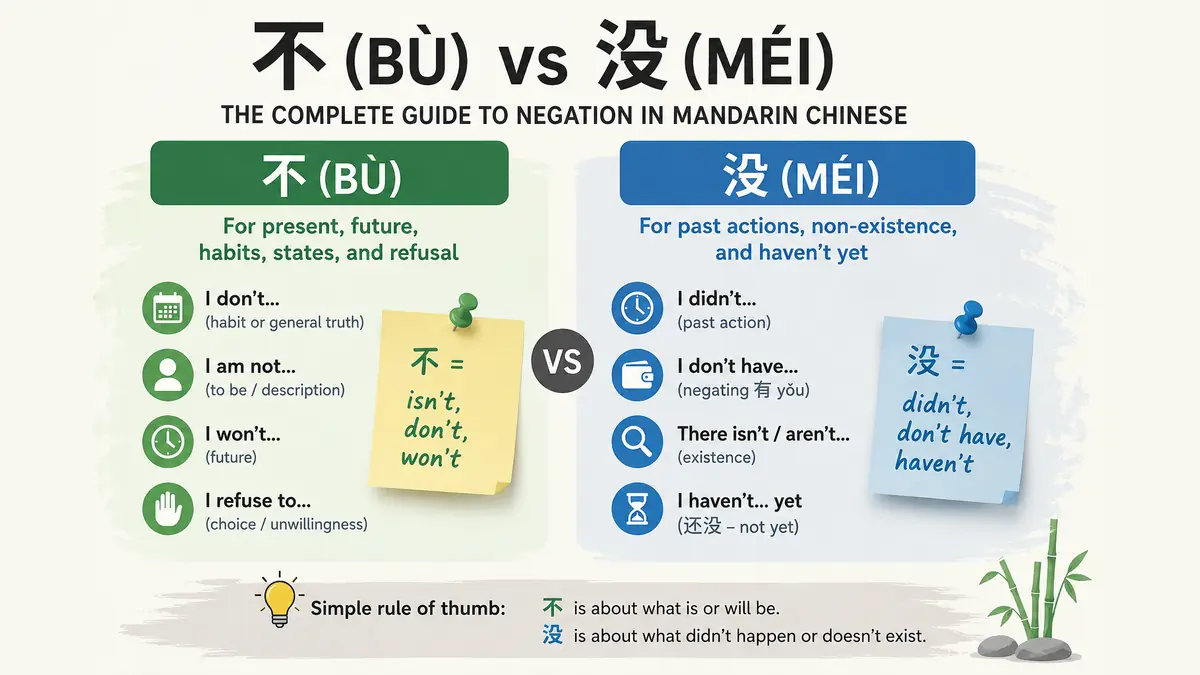
Learning the difference between bu vs mei (不 vs 没) is essential for making accurate negative sentences in Mandarin Chinese.
If you have been learning Mandarin for a while, you have probably stopped in the middle of a sentence and wondered:
Should I use 不 (bù) or 没 (méi)?
I know I did. Both can translate as “not,” but they do different jobs in Mandarin. Choosing the wrong one can make your sentence sound unnatural or change “I didn’t do it” into “I don’t do it.”
The good news is that the main difference is logical once you stop trying to match each word directly with English.
In this guide, you will learn:
- when to use 不 (bù)
- when to use 没 (méi) or 没有 (méiyǒu)
- why past time does not automatically mean 没
- how the two words interact with 了 (le) and 有 (yǒu)
- the most common mistakes beginners make
- natural examples you can use in real conversations
The Quick Answer
| Use | 不 (bù) | 没 / 没有 (méi / méiyǒu) |
|---|---|---|
| Habits and general facts | ✓ | — |
| Preferences and states | ✓ | Sometimes, when a result has not been reached |
| Intentions, refusals and future actions | ✓ | — |
| A specific action did not happen | — | ✓ |
| An action has not happened yet | — | ✓ |
| Possession or existence with 有 | — | ✓ |
| Past experience with 过 | — | ✓ |
A useful beginner memory aid is:
不 (bù) = don’t, won’t or generally isn’t
没 (méi) = didn’t, hasn’t or there isn’t
That shortcut is helpful, but it is not a complete rule. Mandarin does not mark tense in the same way English does. What matters is often whether you are negating a habit, intention or state, or saying that an event did not occur.
For example:
我小时候不喜欢蔬菜。
Wǒ xiǎoshíhou bù xǐhuan shūcài.
I did not like vegetables when I was a child.
This sentence describes a past preference, so it uses 不, even though it refers to the past.
By contrast:
我今天还没吃饭。
Wǒ jīntiān hái méi chīfàn.
I have not eaten today.
This refers to the present day, but it uses 没 because the action has not happened.
That is why “past equals 没” is useful only as a first approximation.
Pronunciation note: The dictionary tone is bù, but before another fourth-tone syllable it is pronounced bú. For example, 不是 is pronounced bú shì and 不去 is pronounced bú qù. The example Pinyin below shows this spoken tone change.
When to Use 不 (Bù)
Use 不 mainly for habits, general facts, preferences, states, intentions, refusals and future actions.
1. Negating 是 (Shì): “To Be”
In standard everyday Mandarin, 是 is negated with 不, forming 不是 (bú shì).
我不是老师。
Wǒ bú shì lǎoshī.
I am not a teacher.
他不是中国人。
Tā bú shì Zhōngguó rén.
He is not Chinese.
这不是我的书。
Zhè bú shì wǒ de shū.
This is not my book.
Do not say:
❌ 没是 (méi shì)
Use:
✅ 不是 (bú shì)
2. Habits and General Behaviour
Use 不 for something a person normally does not do.
我不喝咖啡。
Wǒ bù hē kāfēi.
I do not drink coffee.
她不吃肉。
Tā bù chī ròu.
She does not eat meat.
我不喜欢看电视。
Wǒ bù xǐhuan kàn diànshì.
I do not like watching television.
他平时不说英语。
Tā píngshí bù shuō Yīngyǔ.
He does not usually speak English.
These sentences describe normal behaviour or preference, not one particular occasion.
3. Intentions, Decisions and Refusals
Use 不 when someone decides not to do something or refuses to do it.
我不去。
Wǒ bú qù.
I am not going.
他明天不来。
Tā míngtiān bù lái.
He will not come tomorrow.
我不告诉你。
Wǒ bú gàosu nǐ.
I am not going to tell you.
我不想吃。
Wǒ bù xiǎng chī.
I do not want to eat.
Here, 不 describes intention or willingness. It does not tell us whether an earlier action occurred.
4. Simple States and Qualities
Mandarin adjectives often behave like stative verbs. Their ordinary negative form uses 不.
我不累。
Wǒ bú lèi.
I am not tired.
今天不热。
Jīntiān bú rè.
It is not hot today.
他不高兴。
Tā bù gāoxìng.
He is not happy.
这个菜不好吃。
Zhège cài bù hǎochī.
This dish does not taste good.
For a simple description such as “not hot,” “not tall” or “not expensive,” 不 is normally the correct choice.
When to Use 没 (Méi) or 没有 (Méiyǒu)
Use 没 or 没有 when an action did not occur, has not occurred, or when something does not exist or is not possessed.
Before a verb, 没 and 没有 can often perform the same grammatical job, although 没 is shorter and extremely common in conversation.
1. Saying an Action Did Not Happen
我没去。
Wǒ méi qù.
I did not go.
他没来。
Tā méi lái.
He did not come.
我没吃早饭。
Wǒ méi chī zǎofàn.
I did not eat breakfast.
她没睡觉。
Tā méi shuìjiào.
She did not sleep.
我没看那部电影。
Wǒ méi kàn nà bù diànyǐng.
I did not watch that film.
Each sentence denies that a particular event occurred.
2. Negating 有 (Yǒu): “To Have” or “There Is”
In standard Mandarin, 有 is negated with 没, producing 没有 (méiyǒu).
我没有钱。
Wǒ méiyǒu qián.
I do not have any money.
他没有手机。
Tā méiyǒu shǒujī.
He does not have a mobile phone.
这里没有厕所。
Zhèlǐ méiyǒu cèsuǒ.
There is no toilet here.
家里没有人。
Jiālǐ méiyǒu rén.
There is nobody at home.
Do not say:
❌ 不有 (bù yǒu)
Use:
✅ 没有 (méiyǒu)
3. Saying “Not Yet” With 还没 (Hái Méi)
还没 means an expected action or result has not happened yet.
我还没吃饭。
Wǒ hái méi chīfàn.
I have not eaten yet.
他还没到。
Tā hái méi dào.
He has not arrived yet.
我还没准备好。
Wǒ hái méi zhǔnbèi hǎo.
I am not ready yet.
作业还没做。
Zuòyè hái méi zuò.
The homework has not been done yet.
Notice that 准备好 (zhǔnbèi hǎo) describes reaching the result “ready.” 没 tells us that result has not been reached yet.
4. Talking About Past Experience With 过 (Guo)
Use 没 or 没有 to say you have never had an experience. Unlike perfective 了, the experiential marker 过 stays in the negative sentence.
我去过中国。
Wǒ qùguo Zhōngguó.
I have been to China.
我没去过中国。
Wǒ méi qùguo Zhōngguó.
I have never been to China.
她没吃过这个。
Tā méi chīguo zhège.
She has never eaten this before.
5. Saying an Action Is Not in Progress
For an action that is not happening right now, a common pattern is 没在 + verb.
我没在吃饭。
Wǒ méi zài chīfàn.
I am not eating.
他没在睡觉。
Tā méi zài shuìjiào.
He is not sleeping.
This is different from a habitual negative:
我不吃早饭。
Wǒ bù chī zǎofàn.
I do not eat breakfast.
How the Same Verb Changes Meaning
The verb may stay the same while the negator changes the time, intention or viewpoint.
吃 (Chī): To Eat
我不吃鱼。
Wǒ bù chī yú.
I do not eat fish. — habit or preference
我没吃鱼。
Wǒ méi chī yú.
I did not eat fish. — one occasion
我没在吃鱼。
Wǒ méi zài chī yú.
I am not eating fish right now. — action in progress
去 (Qù): To Go
我不去北京。
Wǒ bú qù Běijīng.
I am not going to Beijing. — intention or decision
我没去北京。
Wǒ méi qù Běijīng.
I did not go to Beijing. — the trip did not happen
说 (Shuō): To Speak or Say
我平时不说中文。
Wǒ píngshí bù shuō Zhōngwén.
I do not normally speak Chinese.
我不会说中文。
Wǒ bú huì shuō Zhōngwén.
I cannot speak Chinese.
我没说那句话。
Wǒ méi shuō nà jù huà.
I did not say that.
These are three different meanings. 不说 describes not speaking or refusing to speak, 不会说 describes inability, and 没说 says a particular act of speaking did not happen.
睡觉 (Shuìjiào): To Sleep
我平时不睡午觉。
Wǒ píngshí bú shuì wǔjiào.
I do not normally take an afternoon nap.
我昨天没睡午觉。
Wǒ zuótiān méi shuì wǔjiào.
I did not take an afternoon nap yesterday.
我现在没在睡觉。
Wǒ xiànzài méi zài shuìjiào.
I am not sleeping now.
What Happens to 了 (Le)?
Mandarin has more than one use of 了, so the beginner rule needs to be stated carefully.
Negating a Completed Event
When verb-attached 了 marks an event as complete, the ordinary negative uses 没 and removes that 了.
我吃了早饭。
Wǒ chī le zǎofàn.
I ate breakfast.
我没吃早饭。
Wǒ méi chī zǎofàn.
I did not eat breakfast.
他来了。
Tā lái le.
He came.
他没来。
Tā méi lái.
He did not come.
For the simple meaning “I didn’t eat,” do not say:
❌ 我没吃了。 (Wǒ méi chī le.)
Use:
✅ 我没吃。 (Wǒ méi chī.)
When a Negative Phrase Can Still End With 了
Sentence-final 了 can mark a new situation or change of state. That is why you may hear negative phrases such as:
我没有钱了。
Wǒ méiyǒu qián le.
I do not have any money now. / I have run out of money.
面包没有了。
Miànbāo méiyǒu le.
There is no bread left.
Here, 了 does not mark a completed positive action. It tells us that the situation has changed.
Another useful contrast is:
我没吃。
Wǒ méi chī.
I did not eat.
我不吃了。
Wǒ bù chī le.
I am not going to eat anymore.
Can 没 Be Used With Adjectives?
For a simple quality, use 不:
今天不热。
Jīntiān bú rè.
It is not hot today.
However, saying that 没 can never appear with an adjective is too absolute.
Comparisons With 没有
The pattern A + 没有 + B + adjective means A is not as adjective as B.
他没有我高。
Tā méiyǒu wǒ gāo.
He is not as tall as me.
这个没有那个贵。
Zhège méiyǒu nàge guì.
This one is not as expensive as that one.
Results That Have Not Been Reached
没 can also negate a change or result:
门没开。
Mén méi kāi.
The door did not open. / The door is not open.
我还没准备好。
Wǒ hái méi zhǔnbèi hǎo.
I am not ready yet.
The beginner rule is therefore:
- use 不 for a simple negative quality
- use 没 when a result has not occurred
- use 没有 in the “not as … as” comparison pattern
Five Common Mistakes
Mistake 1: Thinking Every Past Sentence Uses 没
Compare:
我昨天不舒服。
Wǒ zuótiān bù shūfu.
I was not feeling well yesterday. — past state
我昨天没去上班。
Wǒ zuótiān méi qù shàngbān.
I did not go to work yesterday. — event did not occur
The time word 昨天 does not choose the negator by itself. The meaning does.
Mistake 2: Saying 不有
❌ 我不有时间。
Wǒ bù yǒu shíjiān.
✅ 我没有时间。
Wǒ méiyǒu shíjiān.
I do not have time.
Mistake 3: Using 没 for a Simple Description
For “It is not hot today,” say:
✅ 今天不热。 (Jīntiān bú rè.)
Do not use 今天没热 for that simple meaning. If you mean “It did not become hot today,” you would need a result-focused expression such as:
今天没热起来。
Jīntiān méi rè qǐlái.
It did not warm up today.
Mistake 4: Keeping Perfective 了 After 没
For “I didn’t eat,” use:
✅ 我没吃。 (Wǒ méi chī.)
Do not use:
❌ 我没吃了。 (Wǒ méi chī le.)
Mistake 5: Using 不说 for “Cannot Speak”
我不说中文。 (Wǒ bù shuō Zhōngwén.) means “I do not speak Chinese” or “I will not speak Chinese,” depending on context.
To say that you do not have the ability, use:
我不会说中文。
Wǒ bú huì shuō Zhōngwén.
I cannot speak Chinese.
Quick Reference Guide
| Meaning | Pattern | Example |
| not be | 不是 | 我不是老师。 |
| do not usually | 不 + verb | 我不喝咖啡。 |
| will not / refuse to | 不 + verb | 我明天不去。 |
| simple negative quality | 不 + adjective | 今天不冷。 |
| did not happen | 没(有) + verb | 我没去。 |
| have not done yet | 还没 + verb | 我还没吃饭。 |
| do not have / there is no | 没有 + noun | 我没有时间。 |
| never experienced | 没 + verb + 过 | 我没去过。 |
| not happening now | 没在 + verb | 我没在睡觉。 |
| not as … as | A 没有 B + adjective | 他没有我高。 |
Test Yourself
Choose 不 (bù) or 没 (méi) for each blank.
- I did not call him.
我___给他打电话。
Wǒ ___ gěi tā dǎ diànhuà. - She does not like spicy food.
她___喜欢吃辣的。
Tā ___ xǐhuan chī là de. - There is no water here.
这里___有水。
Zhèlǐ ___ yǒu shuǐ. - He is not a student.
他___是学生。
Tā ___ shì xuésheng. - We did not sleep last night.
我们昨晚___睡觉。
Wǒmen zuówǎn ___ shuìjiào. - I will not go tomorrow.
我明天___去。
Wǒ míngtiān ___ qù. - This bag is not heavy.
这个包___重。
Zhège bāo ___ zhòng. - I have not seen that film yet.
我还___看那部电影。
Wǒ hái ___ kàn nà bù diànyǐng. - I did not like vegetables when I was a child.
我小时候___喜欢蔬菜。
Wǒ xiǎoshíhou ___ xǐhuan shūcài. - I am not watching television now.
我现在___在看电视。
Wǒ xiànzài ___ zài kàn diànshì.
Answers
| Question | Answer | Why? |
| 1 | 没 | The phone call did not happen. |
| 2 | 不 | This is a general preference. |
| 3 | 没, forming 没有 | 有 is negated with 没. |
| 4 | 不, forming 不是 | 是 is negated with 不. |
| 5 | 没 | A particular event did not happen. |
| 6 | 不 | This is a future decision. |
| 7 | 不 | This is a simple quality. |
| 8 | 没, forming 还没 | The action has not happened yet. |
| 9 | 不 | This describes a past preference, not a missing event. |
| 10 | 没, forming 没在 | This negates an action in progress. |
Final Thoughts
Do not worry if you still confuse 不 and 没 occasionally. The difference becomes natural through repeated listening and speaking.
Remember the central contrast:
不 negates a habit, general fact, state, intention, refusal or future action.
没 says that an event did not occur, has not occurred, or that something does not exist.
Then remember the two essential fixed relationships:
- 不是 (bú shì) — is not
- 没有 (méiyǒu) — do not have / there is no
Once you start thinking about what kind of meaning you are negating—not simply whether the English sentence is past or present—your Mandarin will become much more accurate.
Keep Practising With Real Mandarin
Grammar explanations help, but you also need to hear these patterns in complete conversations.
That is one reason I recommend Rocket Chinese. Its audio lessons, native-speaker recordings and pronunciation tools let you hear and practise grammar inside useful spoken phrases.
You can also read my Rocket Chinese Review 2026 to see how the course works and whether it suits your learning style.
Affiliate disclosure: If you buy through my Rocket Languages link, I may earn a commission at no extra cost to you. I only recommend resources I believe can genuinely help Mandarin learners.