
These eight common Mandarin learning mistakes can make Chinese feel harder than it needs to be. Learn how to avoid them and make faster, more confident progress.
I Made Most of These Mandarin-Learning Mistakes Too
When I first started learning Mandarin, I thought I knew what I was doing.
I bought textbooks, downloaded apps and memorised vocabulary lists. I spent hours looking at Chinese characters and felt as though I was making progress.
Then a Chinese person spoke to me—and I froze.
I recognised some of the words, but I couldn’t understand the complete sentence quickly enough. Even when I understood the question, I wasn’t sure how to respond.
Sound familiar?
The problem wasn’t that I wasn’t working hard enough. I simply wasn’t training the skills needed for a real conversation.
After nearly ten years of learning, making mistakes and travelling through China, Hong Kong, and Singapore – and now regularly practising with my Chinese partner, Sunny—I’ve realised that a handful of common mistakes hold many Mandarin learners back.
Here are eight of the biggest mistakes and, more importantly, how to avoid them.
Mistake #1: Waiting Until You’re “Ready” to Speak
This may be the biggest mistake of all.
Many learners believe they need to understand grammar and memorise hundreds of words before they can begin speaking.
You don’t.
You can start using Mandarin from your first day, even if you only know a few simple phrases:
- 你好 (nǐ hǎo) — Hello
- 谢谢 (xièxie) — Thank you
- 我不知道 (wǒ bù zhīdào) — I don’t know
- 请再说一遍 (qǐng zài shuō yí biàn) — Please say it again
- 我听不懂 (wǒ tīngbudǒng) — I don’t understand
Speaking early trains your brain to retrieve and use Mandarin. That is very different from simply recognising a word on a screen.
You will hesitate. You will forget words. You will sometimes use the wrong tone. That is all part of learning.
What to do instead: Choose five useful phrases and practise saying them aloud every day. Use them with a tutor, language partner or native speaker whenever possible.
Mistake #2: Memorising Isolated Vocabulary
Vocabulary is important, but memorising long lists of unrelated words is not enough to prepare you for a conversation.
Instead, learn new words inside useful sentences.
For example, don’t only learn:
吃 (chī) — to eat
Learn it inside a complete sentence:
我喜欢吃中国菜。
Wǒ xǐhuan chī Zhōngguó cài.
I like eating Chinese food.
Now you are learning vocabulary, sentence structure and pronunciation together. You are also learning something you might genuinely say.
The more sentences you learn, the easier it becomes to notice patterns and create your own.
What to do instead: Whenever you learn a new word, put it into at least one sentence that is relevant to your life.
Mistake #3: Ignoring Pronunciation and Tones
Mandarin is a tonal language, and that frightens many beginners. However, tones are not impossible – they simply require regular, careful practice.
Pronunciation involves more than memorising the four main tones. You also need to practise:
- pinyin initials and finals
- tone combinations
- neutral tones
- changes that happen in connected speech
- natural rhythm and sentence flow
It is much easier to build good pronunciation habits at the beginning than to correct deeply established habits later.
One reason I like Rocket Chinese is that it provides native-speaker audio and voice-recognition practice. You can listen, repeat, record yourself and compare your pronunciation.
No voice-recognition system is perfect, but it can encourage you to speak aloud instead of studying silently.
What to do instead: Practise tone pairs and short sentences, not only isolated syllables. Record yourself and compare your pronunciation with native audio.
Mistake #4: Believing You Must Master Thousands of Characters Before Speaking
The idea of memorising thousands of Chinese characters stops many people from even starting Mandarin.
Chinese characters matter, especially if you want to read, write and understand Mandarin properly. However, you do not need to master hundreds of characters before you can begin communicating.
Start by learning pinyin and correct pronunciation. At the same time, gradually introduce common characters connected to the words and sentences you are already studying.
For example, if you are learning the spoken word chī, learn the character 吃 alongside it. This gives the character a sound and meaning instead of making it an abstract drawing.
Pinyin is an excellent pronunciation tool, but it should not permanently replace Chinese characters.
What to do instead: Learn pinyin immediately while gradually adding useful, high-frequency Hanzi from the beginning.
Mistake #5: Using Apps Without a Clear Learning Plan
I made this mistake for years.
I moved between apps, YouTube channels, tutors and different courses. Every resource taught me something, but the information did not always connect.
It felt productive, but my learning was fragmented.
The problem isn’t necessarily using too many or too few resources. The real problem is not having a clear structure.
A better approach is to choose one structured course as your main learning pathway and use other resources for specific purposes.
For example:
- a structured course for your main lessons
- YouTube for extra listening
- podcasts for exposure to natural speech
- flashcards for reviewing vocabulary
- conversations with native speakers for real practice
Each resource should have a clear purpose.
What to do instead: Choose one main course or learning plan. Use other apps and resources to support that plan—not replace it every week.
Mistake #6: Being Afraid of Making Mistakes
Fear held me back for a long time.
I worried about saying the wrong tone. I didn’t want to sound foolish, and I was afraid I might not understand the reply.
In most cases, nothing terrible happened.
Many Mandarin speakers appreciate foreigners making a genuine effort to learn their language. They already know you are learning and do not expect you to speak perfectly.
Making a mistake also gives you useful information. It shows you exactly what needs more practice.
If you wait until your Mandarin is perfect, you will never begin speaking – because nobody becomes perfect before gaining real conversational experience.
What to do instead: Treat every conversation as practice rather than a test. Your goal is successful communication, not a flawless performance.
Mistake #7: Learning Only Textbook Mandarin
Textbook Mandarin is important. It teaches clear pronunciation, standard grammar and complete sentence structures that Mandarin speakers from different regions can understand.
The mistake is learning textbook Mandarin and stopping there.
Real conversations are often faster, shorter and more dependent on context.
For example, a textbook may teach:
你叫什么名字?
Nǐ jiào shénme míngzi?
What is your name?
In an ordinary conversation, you may also hear:
你叫什么?
Nǐ jiào shénme?
What are you called?
After introducing yourself, you might simply ask:
你呢?
Nǐ ne?
And you?
These shorter forms do not make the textbook version wrong. They show how speakers naturally shorten language when the meaning is already obvious.
During my travels to the Far East and through Sunny, who grew up in Shenyang – I became much more aware of regional accents, everyday expressions and conversational shortcuts that rarely appeared in my early study materials.
That is one reason I created Learn Mandarin With Shane: to teach a clear Standard Mandarin foundation while also showing learners how people speak in ordinary life.
What to do instead: Learn the complete standard form first. Then compare it with the shorter, more natural forms used in everyday conversation.
Mistake #8: Expecting Quick Results
Many people study Mandarin for a few months and become discouraged because they are not yet fluent.
Learning Mandarin is a long-term project. There will be periods when your progress feels fast and other periods when nothing seems to be improving.
However, progress gradually accumulates.
One day, you may realise that you understood a sentence without translating it. Later, you may follow part of a real conversation or respond automatically to a familiar question.
These small breakthroughs are signs that your brain is adapting to the language.
Consistent practice is far more valuable than occasionally studying for several hours and then doing nothing for weeks.
What to do instead: Measure progress in small steps. Track the phrases you can use, the characters you recognize and the conversations you understand – not simply whether you are “fluent.”
What Is the Best Way to Learn Mandarin?
If I had to begin learning Mandarin again, I would:
- learn pinyin and pronunciation properly from the beginning
- start speaking immediately
- learn useful sentences instead of isolated words
- study Standard Mandarin before adding regional expressions
- practise listening every day
- learn common Hanzi alongside spoken vocabulary
- use one structured course as my main pathway
- speak with native Mandarin speakers whenever possible
- accept mistakes as a necessary part of learning
- study a manageable amount consistently
Having a structured course is especially useful because it stops your learning from becoming a collection of unrelated apps, videos and vocabulary lists.
I have tried many Mandarin resources over the years. The structured course I continue to recommend is Rocket Chinese.
Its lessons combine native-speaker audio, listening, speaking, pronunciation, grammar, reading and writing in a logical sequence. It won’t make anyone fluent overnight, but it provides a strong structure for learners willing to practise consistently.
Read my complete Rocket Rocket Chinese Review 2026 Chinese Review before deciding whether it is right for you.
Final Thoughts
Mandarin is not impossible, but using the wrong learning methods can make it feel far more difficult than it needs to be.
Start speaking before you feel completely ready. Learn vocabulary in sentences. Take pronunciation seriously, gradually add Chinese characters and build your learning around a clear structure.
Most importantly, don’t allow embarrassment or the fear of making mistakes to stop you.
Every useful phrase you learn brings you closer to a real conversation.
The sooner you begin using Mandarin as a living language, the sooner it stops feeling like another subject you are trying to study.
Happy learning!
Affiliate disclosure: This article contains affiliate links. If you purchase through one of these links, I may earn a commission at no additional cost to you. I only recommend resources I genuinely believe can help Mandarin learners.
Continue Learning
- The Absolute Beginner’s Guide to Learning Mandarin — Build a clear foundation and start speaking Mandarin with confidence.
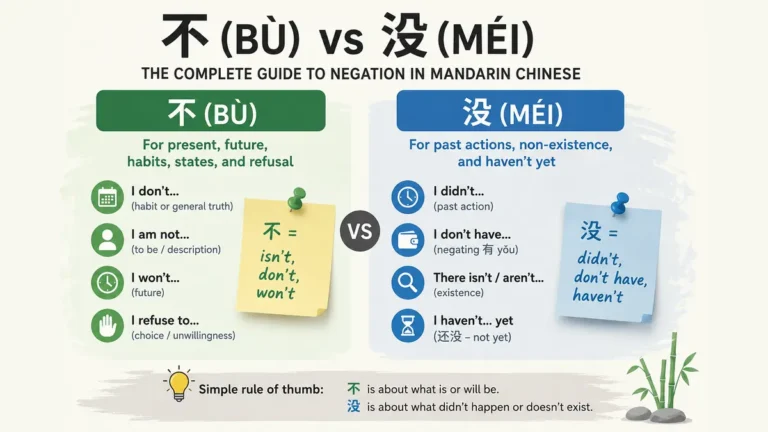
- 不 (Bù) vs 没 (Méi): The Complete Guide — Learn when to use Mandarin’s two most important negative words.
- Rocket Chinese vs Duolingo — Compare the two courses and decide which approach better suits your goals.