From misty mountain plantations to the precision of Gongfu tea — explore thousands of years of Chinese tea culture and discover how learning the language opens an entirely new world of flavour, history and tradition.
In China, tea is never simply a drink.
It can be a greeting, an everyday habit, an expression of hospitality, a craft, a social ritual and, for many people, a lifelong passion.
Chinese legend traditionally credits the mythical emperor 神农 (Shénnóng) with discovering tea nearly 5,000 years ago when leaves supposedly fell into boiling water. That story is an important part of tea mythology rather than documented history. What we do know is that tea has an extraordinarily long history in China, and by the Tang dynasty it had become an established part of social and cultural life. The eighth-century scholar 陆羽 (Lù Yǔ) wrote the famous 《茶经》 (Chájīng) — The Classic of Tea, one of the most influential works ever written about tea.
Picture yourself in a centuries-old teahouse in Chengdu.
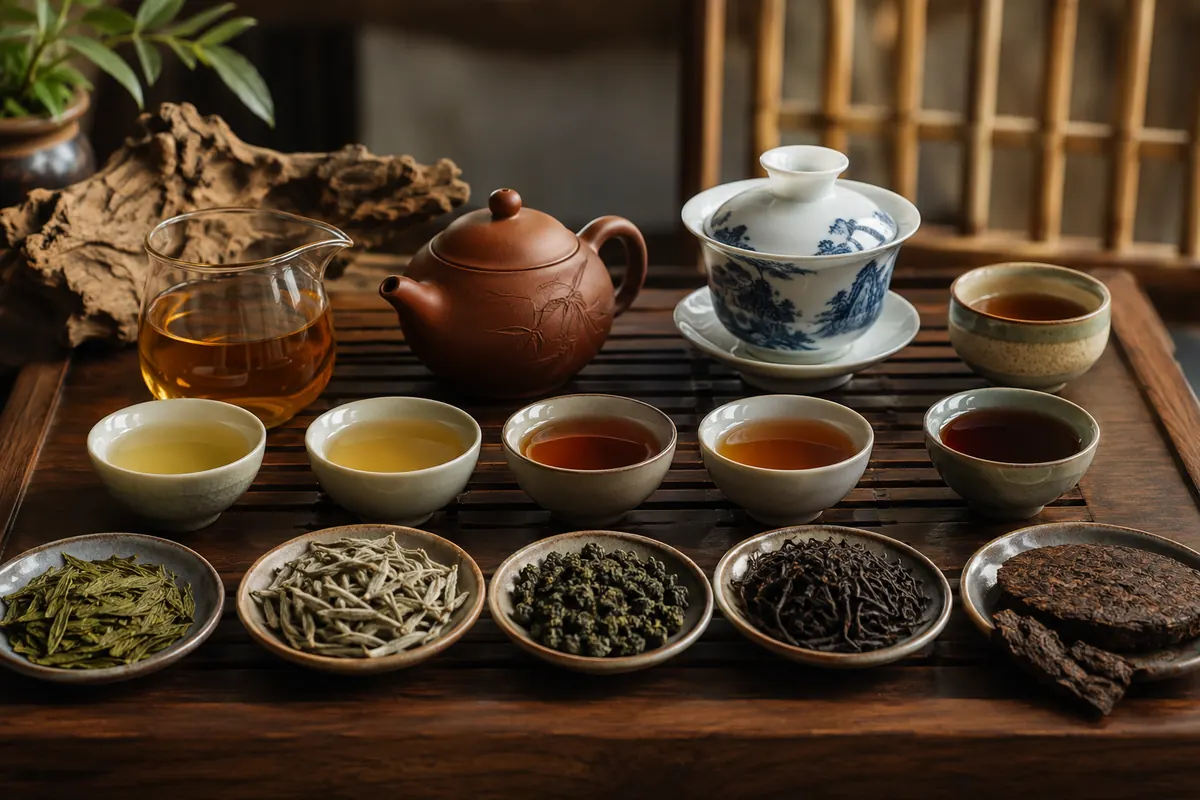
The afternoon light filters through the windows. Small cups sit on a wooden tea tray. Hot water meets the leaves, and an aroma of flowers, roasted grain, fruit or damp forest rises into the air.
Your host pours tea into your cup.
You may not need to say anything.
But if you are learning Mandarin, suddenly you can.
Tea, or 茶 (chá), is one of the most rewarding doorways into Chinese language and culture.
Whether you are drinking delicate green tea in Hangzhou, white tea from Fujian, rock oolong from Wuyi Mountain, Chaozhou-style Gongfu tea in Guangdong, or an aged Pu-erh from Yunnan, every cup has a vocabulary, geography and history of its own.
Chinese traditional tea-processing techniques and the social practices surrounding tea were added to UNESCO’s Representative List of the Intangible Cultural Heritage of Humanity in 2022. Tea remains part of daily life in homes, workplaces, restaurants, teahouses and temples, as well as social occasions and ceremonies.
Let’s pour the first cup.
The Six Great Families of Chinese Tea
One of the first things to understand is that Chinese tea classification works differently from the simple categories many Western drinkers first encounter.
China traditionally recognises six major categories of tea:
| Chinese | Pinyin | English |
|---|---|---|
| 绿茶 | lǜchá | Green tea |
| 白茶 | báichá | White tea |
| 黄茶 | huángchá | Yellow tea |
| 乌龙茶 / 青茶 | wūlóngchá / qīngchá | Oolong tea |
| 红茶 | hóngchá | Black tea |
| 黑茶 | hēichá | Dark tea |
These categories are based primarily on differences in processing and the transformations that take place in the leaf. UNESCO also uses these six categories when describing China’s traditional tea-making heritage.
This is one of the major corrections to the original article: Pu-erh should not simply replace dark tea as the sixth family.
Pu-erh deserves a section of its own because its classification is more complicated, but the standard six-family system includes 黑茶 (hēichá) — dark tea.
绿茶 — Lǜchá — Green Tea
Green tea is one of China’s most familiar and widely enjoyed styles.
Its defining feature is that the freshly picked leaves are heated relatively early in processing. This deactivates the enzymes responsible for most oxidation and helps preserve the greener colour and fresher character of the leaves.
Depending on the tea, you may encounter aromas and flavours that remind you of fresh grass, chestnuts, beans, flowers, seaweed, vegetables or sweet spring air.
Two famous examples are:
龙井 (Lóngjǐng) — Dragon Well tea, strongly associated with Hangzhou and West Lake.
碧螺春 (Bìluóchūn) — a famous curled green tea traditionally associated with Jiangsu.
Green tea is often brewed more gently than heavily oxidised or compressed teas. Water that is too hot or steeping that is too long can make some delicate green teas unnecessarily bitter.
In China, you will also see one of the simplest tea-drinking methods imaginable: leaves placed directly into a glass or bottle and repeatedly topped up with hot water.
Not every Chinese tea experience involves an elaborate ceremony.
Sometimes tea is simply tea.
白茶 — Báichá — White Tea
White tea is known for relatively gentle processing.
Famous white teas, particularly those from Fujian, typically rely heavily on withering and drying rather than the intensive rolling or firing associated with many other tea styles. Fuding white tea, for example, is closely associated with Fujian and includes famous grades such as 白毫银针 (Báiháo Yínzhēn) — Silver Needle.
Good white tea can be wonderfully subtle.
Depending on the tea and its age, you may notice flavours reminiscent of flowers, hay, honey, dried fruit, herbs or gentle sweetness.
白毫银针 (Báiháo Yínzhēn) is made from young buds covered with fine pale hairs and is one of the most recognisable premium white teas.
Another famous type is:
白牡丹 (Bái Mǔdān) — White Peony.
Some white teas are also deliberately aged. As they change over time, their fresh floral character may develop into deeper dried-fruit, herbal and honeyed notes.
Age alone, however, does not automatically make a tea better. The quality of the original material and, especially, storage conditions matter enormously.
黄茶 — Huángchá — Yellow Tea
Yellow tea is one of the rarest of China’s six major tea families.
Its processing shares some characteristics with green tea, but it includes an additional controlled stage generally known as:
闷黄 (mēn huáng)
This is often translated as “sealed yellowing” or “smothering yellow.”
During this stage, warmth and moisture allow subtle chemical changes to take place in the leaves. The process can soften some of the sharp vegetal character associated with certain green teas and create a smoother, rounder flavour.
Because genuine traditional yellow tea is relatively difficult and labour-intensive to produce, it is much less common than green, black or oolong tea.
For many newcomers to Chinese tea, yellow tea becomes one of those categories they discover only after they have already fallen quite far down the tea rabbit hole.
乌龙茶 — Wūlóngchá — Oolong Tea
Oolong is one of the most diverse categories in the entire Chinese tea world.
It occupies a broad range between the minimal oxidation of green tea and the much heavier oxidation associated with black tea.
Some oolongs are pale, fresh and intensely floral.
Others are deeply roasted, mineral, woody and powerful.
Famous examples include:
铁观音 (Tiěguānyīn) — Tieguanyin, strongly associated with Anxi in Fujian.
大红袍 (Dàhóngpáo) — Big Red Robe, one of the best-known names among Wuyi rock teas.
Oolong has a particularly close relationship with small-vessel, repeated-infusion brewing styles. Chaozhou Gongfu tea and Fujian tea traditions have been especially influential in the development of highly skilled ways of brewing oolong.
That does not mean oolong is the only tea suitable for Gongfu brewing. Far from it.
But if you want to understand why people become obsessed with small teapots, tiny cups, precise pouring and infusion after infusion, high-quality oolong is a wonderful place to start.
红茶 — Hóngchá — Black Tea
Here is one of those Chinese language details that beginners remember forever.
What English speakers call black tea is:
红茶 (hóngchá)
Literally:
“red tea.”
The Chinese name refers to the reddish or amber colour of the brewed liquor rather than simply the appearance of the dried leaf.
Chinese black teas can be rich, smooth, fruity, malty, floral, cocoa-like or naturally sweet.
Two famous examples are:
祁门红茶 (Qímén Hóngchá) — Keemun black tea.
滇红 (Diānhóng) — Yunnan black tea.
Keemun processing, for example, traditionally includes stages such as withering, rolling, oxidation — often called “fermentation” in the traditional tea trade — and drying.
Chinese black teas became enormously important in the history of international tea trade and helped shape the tea-drinking cultures that later developed in Europe and elsewhere.
黑茶 — Hēichá — Dark Tea
This is the category that was missing from the original article.
黑茶 (hēichá) means dark tea.
It refers broadly to teas that undergo forms of post-processing microbial transformation and ageing after the initial production stages.
Famous dark-tea traditions include teas from Hunan, Guangxi, Sichuan and other regions.
A well-known example is:
六堡茶 (Liùbǎo Chá) — Liu Bao tea from Guangxi.
Another important dark-tea region is Anhua in Hunan.
Dark teas may be compressed into bricks, cakes or other forms, although they do not have to be.
Their flavours can be extraordinarily different from fresh green tea: woody, earthy, sweet, herbal, nutty or reminiscent of old timber, dried fruit and forest floors.
Storage has an enormous influence on these teas.
Poor storage can ruin them.
Good storage can allow them to develop fascinating complexity.
So Where Does Pu-erh Fit?
Now we reach one of Chinese tea’s most interesting classification questions.
普洱茶 (Pǔ’ěr Chá) comes primarily from Yunnan and is generally divided into two major styles:
生普 (shēng pǔ) — raw Pu-erh.
熟普 (shóu pǔ) — ripe Pu-erh.
Ripe Pu-erh undergoes an accelerated microbial fermentation process designed to produce some of the characteristics associated with naturally aged tea.
Raw Pu-erh begins differently. Young raw Pu-erh can be bright, bitter, floral, fruity and powerful, while properly stored examples may change dramatically over many years.
This is why saying simply “Pu-erh is the sixth Chinese tea family” is misleading.
Contemporary Chinese sources commonly list the six categories as green, white, yellow, oolong, black and dark tea, while Pu-erh is frequently discussed separately because its terminology and classification — particularly raw Pu-erh — do not fit neatly into a simplistic chart. Recent Chinese coverage similarly describes Pu-erh as part of the broader world of dark teas while acknowledging it as a distinctive tradition.
Pu-erh can indeed age for decades, but ageing does not magically improve every tea.
The leaf quality, processing, humidity, temperature, airflow and storage history all matter.
A beautifully stored tea can become extraordinarily complex.
A badly stored tea can simply become badly stored tea.
A Famous Tea Saying
A commonly quoted tea saying appears in several versions:
宁可三日无粮,不可一日无茶。
Nìngkě sān rì wú liáng, bùkě yí rì wú chá.
“Better to go three days without food than one day without tea.”
Versions of this saying are particularly associated with communities in which tea became an essential part of the daily diet and social life.
It should not be treated as something every Chinese person walks around quoting.
But it captures something genuine:
For many communities, tea historically became far more than a luxury.
It became part of life.
The Sacred Vessels — Chinese Teaware
Chinese tea becomes even more fascinating when you begin exploring the equipment used to prepare it.
A brewing vessel is not merely decorative.
Its material, size, wall thickness, opening, shape and pouring speed can all affect how easy it is to control temperature, infusion time and leaf movement.
But this is where tea culture can sometimes drift from practical experience into rigid folklore.
You will occasionally hear claims such as:
“This exact teapot shape must be used for this exact tea.”
Treat those rules cautiously.
Tea experts often develop strong preferences, but there is no universal scientific chart matching every traditional pot shape to one tea.
Experimentation is part of the pleasure.
宜兴紫砂壶 — Yíxīng Zǐshā Hú
Yixing Purple-Clay Teapots
Among the most famous teapots in China are those made from 紫砂 (zǐshā) clay associated with Yixing in Jiangsu province.
Yixing’s purple-clay tradition became especially important during the Ming dynasty, a period when loose-leaf steeping became increasingly prominent and teapots themselves became central to tea preparation. Official material from Yixing describes fired zisha as having a porous or breathable structure and a long connection with Chinese tea culture.
Unlike glazed porcelain, traditional Yixing ware is unglazed.
Tea enthusiasts often dedicate one Yixing pot to a particular broad tea family because aromatic compounds can gradually interact with the unglazed surface.
For example, someone might keep one pot for roasted oolong and another for ripe Pu-erh.
However, claims that an old pot dramatically “absorbs the soul of the tea” or automatically makes every infusion better should be treated as tea tradition rather than hard scientific fact.
There is still a practical reason for keeping strong-flavoured teas separate:
You don’t necessarily want years of roasted oolong aromas appearing in your delicate tea.
Should You Wash a Yixing Pot With Soap?
Traditional advice is to avoid ordinary scented dishwashing detergent.
Because unglazed clay can retain odours, a strongly perfumed detergent is not something you want flavouring the next pot of tea.
For routine care, many tea drinkers simply rinse the pot thoroughly with clean hot water and allow it to dry completely.
Cleanliness still matters.
“Never use soap” should not be interpreted as “never clean your teapot.”
Traditional Yixing Teapot Shapes
The world of Yixing teapots becomes almost addictive once you begin recognising traditional forms.
The names are not simply random labels. Many refer to historical objects, people or aesthetic ideas.
西施壶 — Xīshī Hú
The Xishi pot has a soft, rounded body and flowing lines.
Its name refers to 西施 (Xīshī), one of the legendary beauties of ancient China.
The rounded internal space can give rolled or expanding leaves plenty of room, which is one reason many tea drinkers enjoy using this style.
It is elegant, simple and comfortable in the hand.
But it is not restricted to a single tea.
扁壶 — Biǎn Hú
扁壶 (biǎn hú) simply describes a flatter style of teapot.
Compared with a tall rounded pot, the lower, broader chamber changes how the leaves sit and how heat behaves inside the vessel.
Some tea drinkers enjoy flat pots for large or rolled leaves because the horizontal space allows them to expand differently.
Again, this is preference rather than law.
石瓢壶 — Shípiáo Hú
The Shípiáo, or Stone Scoop pot, is one of the classic Yixing forms.
It has a strong geometric profile, a broad base and a shape that feels stable and disciplined.
It is particularly admired within the world of traditional Chinese teapot craftsmanship.
Rather than saying it is “the correct pot” for aged Pu-erh or dark oolong, it is more accurate to say that many drinkers enjoy using its practical shape with a range of teas.
仿古壶 — Fǎnggǔ Hú
仿古 (fǎnggǔ) literally conveys the idea of imitating or evoking antiquity.
The Fǎnggǔ teapot has a broad, rounded classical form and is one of the most recognisable Yixing shapes.
Its generous body makes it versatile.
龙蛋壶 — Lóngdàn Hú
The Dragon Egg pot has an elegant oval or egg-like body.
Its almost continuous curves give it a soft, organic appearance.
The name alone demonstrates how Chinese teaware combines practical craftsmanship with poetry and symbolism.
井栏壶 — Jǐnglán Hú
The Jǐnglán, or Well-Curb pot, takes inspiration from the stone structures traditionally found around Chinese wells.
Its shape is typically cylindrical, restrained and architectural.
This is one of the pleasures of learning Chinese tea vocabulary:
A teapot stops being merely “a brown pot.”
It acquires a name, a history and a design language.
盖碗 — Gàiwǎn — The Lidded Bowl
If I had to recommend one traditional Chinese brewing vessel to a beginner, it would probably be the 盖碗 (gàiwǎn).
A traditional gaiwan consists of a bowl, lid and saucer.
Because porcelain and glazed ceramic do not absorb aroma in the same way as unglazed clay, a gaiwan allows you to move easily between different teas.
You can brew white tea in the morning, oolong in the afternoon and black tea at night without needing three separate vessels.
A gaiwan also gives you excellent control over infusion time.
Tilt the lid slightly.
Hold back the leaves.
Pour.
Simple — once you learn how not to burn your fingers.
公道杯 — Gōngdào Bēi — Fairness Pitcher
The 公道杯 (gōngdào bēi) is one of the most practical pieces of equipment on a modern Gongfu tea table.
Tea is poured from the brewing vessel into the fairness pitcher before being distributed among the drinking cups.
Why?
Imagine pouring directly from a teapot into four cups.
The first cup receives tea that left the pot first.
The final cup contains tea that remained with the leaves longer.
The strength may therefore differ.
Pouring the complete infusion into the fairness pitcher mixes the liquor before serving, making each person’s cup more consistent.
That is where the charming English translation “fairness cup” comes from.
闻香杯 — Wénxiāng Bēi — Aroma Cup
The 闻香杯 (wénxiāng bēi) is a tall, narrow cup used for appreciating fragrance.
It is especially associated with certain formalised oolong tasting traditions, particularly Taiwanese-style tea service.
Tea may be poured into the tall aroma cup and then transferred to the drinking cup.
The empty aroma cup is brought toward the nose so the lingering fragrance can be appreciated.
It is beautiful when used well.
But it is worth correcting another common misconception:
Aroma cups are not a compulsory part of every Chinese Gongfu tea session.
Many experienced tea drinkers never use them at all.
茶宠 — Cháchǒng — Tea Pets
Now we get to one of the most charming parts of the tea table.
茶宠 (cháchǒng) means tea pet.
These are small clay figures that sit on the tea tray.
Leftover tea or hot water may be poured over them during a tea session. Over time, some develop a darker, smoother patina.
You may see frogs, dragons, pigs, monks, mythical creatures or the famous three-legged money toad.
A 貔貅 (píxiū) — the mythical Chinese creature associated with wealth and protection — is another popular design.
They are partly decorative, partly playful and often deeply personal.
A tea pet that has sat beside someone through thousands of cups of tea becomes part of the tea table’s history.
茶盘 — Chápán — Tea Tray
The 茶盘 (chápán) forms the practical base of many Gongfu tea setups.
Small-vessel brewing often involves rinse water, overflow and repeated pouring.
A tea tray gives that water somewhere to go.
Some have removable reservoirs.
Others drain through a tube into a container below the table.
Modern tea trays range from simple bamboo designs to elaborate stone, ceramic and hardwood pieces.
Gongfu Tea — 工夫茶 / 功夫茶
This section needed another important correction.
You’ll see both 工夫茶 and 功夫茶 written in English-language tea material.
In the context of the traditional Chaozhou tea practice, 工夫茶 is an important spelling, while 功夫茶 is extremely widespread in modern usage.
The word gōngfu goes far beyond martial arts. It carries the idea of skill, time and effort developed through practice.
That is exactly what this style of tea demands.
Gongfu tea is particularly associated with southeastern Chinese traditions, especially Chaozhou in Guangdong and tea cultures of Fujian. UNESCO specifically identifies Chaozhou with its Gongfu tea heritage, and modern Chaozhou practice emphasises careful preparation, brewing and social sharing.
The basic principle is easy to understand:
Use a relatively high ratio of leaves to water, a small brewing vessel and a succession of short infusions.
A modern description of Chaozhou Gongfu tea similarly emphasises small pots and cups and repeated short infusions designed to reveal changing flavours.
Rather than producing one enormous mug, you explore the same leaves repeatedly.
The first infusion may be intensely aromatic.
The next may become sweeter.
Another may reveal mineral notes.
Another may suddenly taste like fruit.
A good tea changes.
That changing character is one of the great joys of Gongfu brewing.
There Is No Single Universal Gongfu Ceremony
This is worth emphasising.
You will find websites giving precise lists such as:
“Step 1, Step 2, Step 3…”
Those can be useful for learning.
But Chinese tea culture varies enormously by region, teacher, tea, setting and family tradition.
There is no single six-step ceremony followed identically throughout China.
A casual tea session between friends in Chaozhou will not necessarily look like a staged tea-art performance in Shanghai.
A tea shop may brew differently from a family home.
A Pu-erh enthusiast may do things differently from someone brewing Dancong oolong.
So use the following sequence as a practical beginner framework rather than an ancient universal script.
Warming the Teaware — 温器 / 温壶
Hot water is commonly used to warm the brewing vessel and drinking cups.
This helps stabilise temperature and also rinses away any dust that may have settled on clean teaware.
The Chinese terminology varies depending on what is being warmed.
温壶 (wēn hú) specifically means warming the pot.
Adding the Tea — 投茶
投茶 (tóu chá) means adding the tea leaves to the brewing vessel.
Once dry leaves enter a warm pot or gaiwan, their aroma can become much stronger.
This is a wonderful moment to smell the leaf before adding water.
A tightly rolled oolong may smell completely different once it warms.
Should You Rinse the Tea? — 洗茶
The original article stated that the first infusion is poured away as though this is always required.
It isn’t.
洗茶 (xǐ chá) means rinsing the tea.
A quick rinse is common with many compressed Pu-erhs, dark teas and some oolongs. It can help loosen compressed leaves and prepare them for brewing.
But automatically rinsing every tea is unnecessary.
With delicate green tea, high-quality white tea or highly aromatic fresh tea, you may simply throw away some of the most fragrant part of the experience.
Tea people disagree about this.
That is normal.
Brewing — 冲泡
冲泡 (chōngpào) means to infuse or brew.
In Gongfu-style preparation, brewing time may be surprisingly short.
Sometimes only a matter of seconds.
Water temperature, leaf quantity, vessel size and infusion time are adjusted according to the tea and the drinker’s preference.
There is no magic number that works for every leaf.
Learning to adjust is part of developing gōngfu.
Pouring Into the Fairness Pitcher
When using a 公道杯 (gōngdào bēi), the entire infusion is poured out of the brewing vessel.
This is important because leaving liquid sitting on the leaves between rounds can continue extracting the tea and produce unwanted bitterness.
From the fairness pitcher, tea is distributed among the cups.
品茶 — Pǐn Chá — Appreciating the Tea
品茶 (pǐn chá) means more than simply swallowing tea.
The character 品 (pǐn) is associated with tasting, appreciating or evaluating.
You might notice the dry-leaf aroma.
Then the wet-leaf aroma.
Then the fragrance of the liquor.
Then texture.
Sweetness.
Bitterness.
Minerality.
Body.
Aftertaste.
Chinese tea drinkers often talk about:
回甘 (huígān)
This refers to a returning sweetness that can emerge after an initial bitterness or astringency.
It is one of the most useful words you can learn if you begin drinking serious Chinese tea.
Ending the Session
The original post included a formal sixth step called:
谢茶 (xiè chá) — “Thanking the tea.”
There is nothing wrong with expressing gratitude at the end of a tea session, but presenting 谢茶 as a universal formal final stage of Gongfu tea would be misleading.
Some tea-art systems and teachers have their own ceremonial sequences.
Ordinary Gongfu brewing does not require a universally prescribed “Thanking the Tea” stage.
Usually the session simply winds down as the leaves lose flavour.
Conversation continues.
The final cups are poured.
The wet leaves may be examined.
And eventually the teaware is cleaned.
Sometimes the best ending to a tea session is no ceremony at all.
Just:
再来一泡?
Zài lái yí pào?
“One more infusion?”
Chinese Tea Etiquette — Useful Traditions Without Turning Them Into Rules
Tea etiquette is fascinating, but it is easy for foreign-language guides to make it sound more rigid than it really is.
China is enormous.
Practices vary between Guangdong, Fujian, Sichuan, Beijing, Yunnan, Hong Kong, Taiwan and countless other places.
Family habits also vary.
So think of the following as traditions you may encounter rather than laws every Chinese person follows.
叩手礼 — Kòushǒu Lǐ — The Finger Tap
One of the best-known tea gestures is tapping the table lightly with the fingers after someone pours tea for you.
It acts as a silent:
谢谢 (xièxie) — thank you.
The gesture is especially strongly associated with southern Chinese tea culture and is widely seen in Guangdong and Hong Kong, although many people elsewhere recognise it too.
You may hear colourful legends explaining its origins, often involving an emperor travelling in disguise.
Those stories are entertaining.
They should be treated as legends rather than established historical fact.
Should You Accept the First Cup?
The original article said:
“Never refuse the first cup.”
That is too absolute.
Accepting tea offered by a host is usually a warm and polite response to hospitality, and tea plays an important role in welcoming guests and building social relationships. UNESCO specifically notes tea’s role in hospitality and social interaction within Chinese communities.
But there is no national rule saying you must drink tea regardless of circumstances.
If you do not want caffeine, have a medical reason, dislike the tea or simply do not want another cup, you can politely decline.
Culture matters.
So does common sense.
Who Gets Served First?
In more formal situations, the host may serve honoured guests, elders or senior people before others.
Respect for age and status can influence service.
But once again, this varies.
At a relaxed tea session among friends, nobody may be thinking about hierarchy at all.
The important lesson for a Mandarin learner is to observe what the host is doing rather than trying to memorise a rigid etiquette manual.
The Attentive Host
A good host often watches the guests’ cups closely and offers more tea before they have to ask.
That does not mean a cup must literally never be empty.
Sometimes an empty cup simply means:
“I have had enough.”
Tea communication can be quiet.
Pay attention to gestures as well as words.
Essential Chinese Tea Vocabulary
| Chinese | Pinyin | English |
| 茶 | chá | tea |
| 工夫茶 / 功夫茶 | gōngfu chá | Gongfu tea |
| 茶壶 | cháhú | teapot |
| 茶杯 | chábēi | teacup |
| 盖碗 | gàiwǎn | lidded brewing bowl |
| 公道杯 | gōngdào bēi | fairness pitcher |
| 茶盘 | chápán | tea tray |
| 茶宠 | cháchǒng | tea pet |
| 泡茶 | pào chá | to make/brew tea |
| 喝茶 | hē chá | to drink tea |
| 品茶 | pǐn chá | to taste/appreciate tea |
| 请喝茶 | qǐng hē chá | please have some tea |
| 茶艺 | cháyì | tea art / tea-making arts |
| 茶道 | chádào | the Way of Tea / tea philosophy |
| 好喝 | hǎohē | tastes good; delicious to drink |
| 香 | xiāng | fragrant |
| 苦 | kǔ | bitter |
| 甜 | tián | sweet |
| 回甘 | huígān | returning sweet aftertaste |
| 茶叶 | cháyè | tea leaves |
| 开水 | kāishuǐ | boiled/hot water |
| 再来一泡 | zài lái yí pào | brew another infusion |
Notice that 好喝 (hǎohē) is used for something that tastes good to drink.
For food, you will often hear:
好吃 (hǎochī) — delicious / good to eat.
So if someone pours you a beautiful tea, you can simply say:
这个茶很好喝。
Zhège chá hěn hǎohē.
This tea tastes really good.
Or:
这茶真香。
Zhè chá zhēn xiāng.
This tea is really fragrant.
Simple Mandarin can completely change the experience.
Tea Is a Language — Learn Both
There is a reason so many Chinese social moments involve tea.
Tea welcomes guests.
Tea fills the silence between conversations.
Tea can accompany business meetings, family visits, friendships and celebrations.
It can be intensely serious or completely ordinary.
That is what makes it so interesting.
You do not have to understand every teapot shape or identify a Wuyi oolong blindfolded to participate.
You can begin with one question:
你喜欢喝什么茶?
Nǐ xǐhuān hē shénme chá?
What kind of tea do you like to drink?
You might ask:
这是什么茶?
Zhè shì shénme chá?
What tea is this?
Or:
这个茶是哪里产的?
Zhège chá shì nǎli chǎn de?
Where is this tea produced?
Then suddenly the conversation opens.
Someone tells you about their hometown.
Their father drank this tea.
Their grandmother brewed that tea.
Their family buys tea from a particular village every year.
A simple cup becomes a story.
That is one of the great rewards of learning Mandarin.
You are no longer standing outside the culture trying to understand what is happening.
You can ask.
You can listen.
You can take part.
The Mandarin Hidden Inside the Tea Table
Tea is also a fantastic way to learn Chinese because so much useful language repeats naturally.
水 (shuǐ) — water.
杯子 (bēizi) — cup.
热 (rè) — hot.
凉 (liáng) — cool.
香 (xiāng) — fragrant.
甜 (tián) — sweet.
苦 (kǔ) — bitter.
再来一点 (zài lái yìdiǎn) — have a little more.
够了 (gòu le) — that’s enough.
谢谢 (xièxie) — thank you.
You are not memorising vocabulary for an imaginary textbook exercise.
You are using the words while the object is sitting directly in front of you.
That makes vocabulary easier to remember.
A Simple Tea Conversation
Imagine your host pours you a cup.
They ask:
好喝吗?
Hǎohē ma?
Does it taste good?
You answer:
很好喝。很香。
Hěn hǎohē. Hěn xiāng.
It’s really good. Very fragrant.
Then ask:
这是什么茶?
Zhè shì shénme chá?
What tea is this?
They say:
铁观音。
Tiěguānyīn.
Tieguanyin.
You ask:
福建的吗?
Fújiàn de ma?
Is it from Fujian?
That is already a real conversation.
Nothing complicated.
Nothing advanced.
But you are participating in Chinese culture through Chinese.
Why I Recommend Rocket Languages Chinese
I have tried apps, books, videos and different approaches to Mandarin over the years.
One thing I have learned is that isolated vocabulary is never enough.
You need to hear the language.
You need repetition.
You need complete sentences.
You need to hear how words change when native speakers actually put them together.
That is why I personally like structured, audio-based study alongside real-life practice.
Rocket Languages Chinese combines structured lessons with listening, speaking, pronunciation and cultural material.
It will not magically make you fluent.
No course will.
But a structured course can give you the framework you need so that real-world experiences — like sitting around a Chinese tea table — begin making sense.
You learn a phrase in a lesson.
Then one day you hear somebody actually use it.
That moment is incredibly satisfying.
The More You Learn, the Deeper Tea Becomes
At first, you see:
tea.
Then you learn:
茶 (chá).
Later you recognise:
绿茶 (lǜchá)
红茶 (hóngchá)
乌龙茶 (wūlóngchá)
白茶 (báichá)
黄茶 (huángchá)
黑茶 (hēichá)
Then you discover:
龙井 (Lóngjǐng)
铁观音 (Tiěguānyīn)
大红袍 (Dàhóngpáo)
普洱 (Pǔ’ěr)
Then suddenly you are discussing regions, mountains, harvests, processing, teapots, water temperature and storage.
The same thing happens with Mandarin itself.
At first:
你好。
Nǐ hǎo.
Hello.
Then:
你喜欢喝什么茶?
Nǐ xǐhuān hē shénme chá?
Then one day you are sitting at a table in China having an actual conversation.
That is the real beauty of language learning.
Every new word reveals another layer of the world.
Final Thoughts
Chinese tea culture is too large to fit into one article.
There are entire worlds we have barely touched:
Song dynasty tea.
Wuyi rock tea.
Phoenix Dancong.
Ancient Yunnan tea trees.
Tea mountains.
Tea storage.
Water chemistry.
Wood-fired teaware.
Jian ware.
Porcelain.
Tea competitions.
Tea houses.
Tea markets.
Modern Chinese milk tea.
Regional traditions.
And thousands upon thousands of individual teas.
That is what makes the subject so addictive.
You never really finish learning it.
And perhaps that is the point.
The next time someone hands you a small Chinese teacup, do not just drink it.
Look at the colour.
Smell the aroma.
Ask where it comes from.
Learn its Chinese name.
Listen to the story behind it.
Then take another sip.
Because once you begin understanding both the tea and the language surrounding it, a simple cup of 茶 (chá) becomes something much bigger.
It becomes a doorway into China itself.