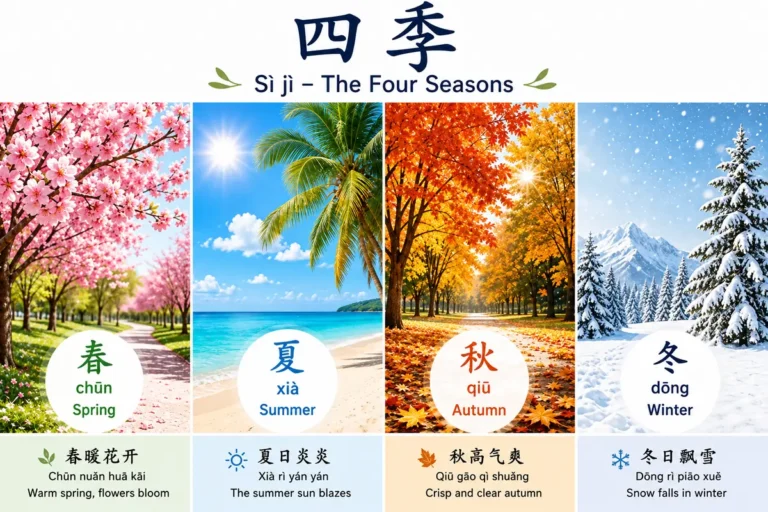

If you want to learn real conversational Mandarin, there is one topic you absolutely cannot avoid:
The weather.
At first, it sounds almost too simple to matter. Most beginners focus on ordering food, introducing themselves, asking for directions, or memorising travel phrases.
But once you spend time around Chinese speakers, you quickly notice something:
Weather comes up all the time.
And it is not always meaningless small talk.
Weather can connect naturally to health, clothing, food, travel, daily routines, and expressions of care. Whether you are messaging someone on WeChat, talking with family, working with Chinese colleagues, or chatting with a Chinese partner, weather gives you an easy way to start and continue everyday conversations.
Once you understand how people actually talk about weather in Mandarin, your Chinese starts sounding much more natural.
Why Weather Matters in Everyday Chinese Conversation
Weather conversation exists everywhere, but in Chinese-speaking communities it often overlaps with practical concern for another person’s wellbeing.
You may hear things like:
多穿一点。
Duō chuān yìdiǎn.
Wear a little more.
注意保暖。
Zhùyì bǎonuǎn.
Keep warm.
小心别感冒了。
Xiǎoxīn bié gǎnmào le.
Be careful not to catch a cold.
These sentences are about temperature, but they can also be expressions of care.
Someone reminding you to wear a jacket, stay warm, eat properly, or take care of yourself may simply be showing concern in a practical way.
This is worth understanding because affection and friendliness are not always expressed in exactly the same way across languages and cultures.
Essential Mandarin Weather Vocabulary
Fortunately, basic weather vocabulary in Mandarin is quite straightforward.
| English | Hanzi | Pinyin |
|---|---|---|
| weather | 天气 | tiānqì |
| hot | 热 | rè |
| cold | 冷 | lěng |
| warm | 暖和 | nuǎnhuo |
| pleasantly cool | 凉快 | liángkuai |
| rain | 雨 | yǔ |
| snow | 雪 | xuě |
| wind | 风 | fēng |
| cloudy | 多云 | duōyún |
| sunny / clear | 晴 | qíng |
| sunny day | 晴天 | qíngtiān |
| humid | 潮湿 | cháoshī |
| muggy | 闷热 | mēnrè |
Two particularly useful weather verbs are:
下雨
xià yǔ
to rain
下雪
xià xuě
to snow
The character 下 (xià) normally means “down” or “to go down,” so you can think of these quite literally as rain or snow falling from the sky.
The Weather Sentence Pattern You Will Use Constantly
A very useful beginner pattern is:
今天 + 很 + adjective
For example:
今天很冷。
Jīntiān hěn lěng.
It’s cold today.
今天很热。
Jīntiān hěn rè.
It’s hot today.
You can also include 天气 (tiānqì):
今天天气很好。
Jīntiān tiānqì hěn hǎo.
The weather is nice today.
One important point for beginners is that 很 (hěn) does not always carry the strong English meaning of “very.”
In simple adjective sentences, it often helps connect the subject and adjective naturally.
So:
天气很好。
can simply mean:
The weather is good.
It does not necessarily mean the weather is very good.
Useful Weather Sentences for Everyday Conversation
Here are some sentences you can begin using immediately.
今天天气不错。
Jīntiān tiānqì búcuò.
The weather is pretty good today.
今天真冷。
Jīntiān zhēn lěng.
It’s really cold today.
今天太热了。
Jīntiān tài rè le.
It’s too hot today.
外面很冷。
Wàimiàn hěn lěng.
It’s cold outside.
外面下雨了。
Wàimiàn xià yǔ le.
It’s raining outside.
好像要下雨了。
Hǎoxiàng yào xià yǔ le.
It looks like it’s going to rain.
今天风很大。
Jīntiān fēng hěn dà.
It’s very windy today.
Literally, Chinese says the wind is “big”:
风很大
fēng hěn dà
That is a very common Mandarin expression.
Talking About Extreme Weather
Chinese speakers often use very expressive language when the weather is uncomfortable.
One of the most common examples is:
热死了!
Rè sǐ le!
I’m dying from the heat!
Literally, it means something like “hot to death.”
But do not take it literally. It is simply an exaggerated and very natural way to say:
It’s unbelievably hot!
You can do the same thing with cold:
冷死了!
Lěng sǐ le!
I’m freezing!
This adjective + 死了 pattern appears frequently in casual spoken Mandarin.
Weather in Northeast China
China is enormous, so weather and everyday life can vary dramatically from one region to another.
Northeast China — commonly called 东北 (Dōngběi) — includes places such as:
- Shenyang
- Harbin
- Changchun
Winters can be extremely cold, with snow, ice, frozen roads, and long periods below freezing.
So phrases about keeping warm become extremely useful.
外面太冷了。
Wàimiàn tài lěng le.
It’s too cold outside.
多穿点。
Duō chuān diǎn.
Wear a bit more.
You may also hear the northern-style 儿化 (érhuà) pronunciation:
多穿点儿。
Duō chuān diǎnr.
The meaning is the same.
Practical reminders about coats, hats, heating, food, and staying warm naturally become part of everyday conversation when winter temperatures are severe.
Weather in Southern China
Southern China creates a completely different vocabulary.
Cities such as Guangzhou, Shenzhen, and Fuzhou experience much warmer and more humid conditions for large parts of the year.
Humidity and muggy weather therefore come up regularly.
今天特别潮湿。
Jīntiān tèbié cháoshī.
It’s especially humid today.
In casual conversation you might also hear:
今天太潮了。
Jīntiān tài cháo le.
It’s so humid today.
Another extremely useful word is:
闷热
mēnrè
hot and muggy
For example:
今天又闷又热。
Jīntiān yòu mēn yòu rè.
It’s muggy and hot today.
And of course:
热死了!
Rè sǐ le!
I’m dying from the heat!
You will hear expressions like this constantly during a hot Chinese summer.
Weather Small Talk Is a Great Conversation Starter
Beginners sometimes dismiss weather conversation because it seems too basic.
That is a mistake.
Simple conversations are exactly how real relationships and language skills develop.
You do not need advanced vocabulary to have a genuine interaction.
Try sentences like:
最近挺冷的。
Zuìjìn tǐng lěng de.
It’s been pretty cold lately.
你那边下雨了吗?
Nǐ nàbiān xià yǔ le ma?
Has it rained where you are? / Is it raining where you are?
今天天气不错。
Jīntiān tiānqì búcuò.
Nice weather today.
你那边冷不冷?
Nǐ nàbiān lěng bu lěng?
Is it cold where you are?
These are easy questions to send on WeChat because they naturally invite the other person to answer.
Weather Can Also Be a Way of Showing Care
One of the interesting things about learning another language is discovering that affection is not always communicated with the same words.
In English-speaking cultures, people may frequently say:
“I love you.”
“I miss you.”
“Take care.”
But in Chinese, affection can also appear through practical questions and reminders.
You might hear:
吃饭了吗?
Chīfàn le ma?
Have you eaten?
开车慢点。
Kāichē màn diǎn.
Drive carefully / Slow down when driving.
别熬夜。
Bié áoyè.
Don’t stay up too late.
And when the weather changes:
记得带外套。
Jìde dài wàitào.
Remember to bring a jacket.
晚上会很冷。
Wǎnshang huì hěn lěng.
It will be cold tonight.
注意保暖。
Zhùyì bǎonuǎn.
Keep warm.
Of course, not every Chinese person communicates in the same way. China is enormous, generations differ, and individual personalities matter.
But practical expressions of concern are very common, and recognising them can help you understand the emotional meaning behind everyday Mandarin.
Why Listening Matters More Than Memorising
You can memorise every weather word on this page and still struggle when a native speaker says one of them quickly.
That is why listening matters so much.
Instead of learning only:
冷 = cold
learn complete phrases:
今天很冷。
Jīntiān hěn lěng.
外面太冷了。
Wàimiàn tài lěng le.
你那边冷不冷?
Nǐ nàbiān lěng bu lěng?
This trains your brain to recognise words as part of real speech rather than as isolated vocabulary.
Listen, repeat, and say the complete sentence aloud.
That is far more useful than simply staring at vocabulary lists.
If you prefer structured audio-based study alongside your everyday Mandarin practice, Rocket Languages Chinese is one option worth looking at. I particularly like combining structured lessons with real conversations, because the course gives you a foundation while everyday speaking teaches you how the language is actually used.
Mandarin Grammar Is Different — Not Necessarily Easy
You will often hear people say that Mandarin grammar is easy.
There is some truth to that.
Mandarin verbs do not change depending on the person speaking:
我吃
wǒ chī
I eat
你吃
nǐ chī
you eat
他吃
tā chī
he eats
There is no equivalent of English verb changes such as:
“I eat.”
“He eats.”
“I ate.”
Mandarin also does not have grammatical gender like many European languages.
But that does not mean Mandarin has no grammar.
Word order, aspect particles such as 了 (le), result complements, measure words, sentence-final particles, and other structures become increasingly important as you progress.
For beginners, though, Mandarin sentence building can often feel refreshingly direct.
The Real Goal Is Communication, Not Perfection
You do not need perfect tones or advanced grammar before you start speaking Mandarin.
Weather gives you one of the easiest ways to practise.
Start with:
今天很冷。
Jīntiān hěn lěng.
Then try:
你那边冷不冷?
Nǐ nàbiān lěng bu lěng?
Then:
记得多穿点。
Jìde duō chuān diǎn.
Remember to wear a little more.
Suddenly you are no longer just memorising Chinese.
You are using it to communicate with another person.
And that is the real goal.
The next time the temperature changes, it rains, the wind picks up, or someone tells you to bring a jacket, pay attention.
You may be hearing much more than a conversation about the weather.