One of the first things I noticed when spending time around Chinese people was how often everyday conversations came back to the weather.
At first, I thought it was simply small talk. But after a while, I realised that talking about the weather and the changing seasons can be connected to much more than temperature.
Food changes with the weather. Daily habits change. People remind each other to wear more clothes, drink something warm, or be careful not to get cold. Festivals, family traditions and even poetry are closely connected to different times of the year.
Learning how to talk about the seasons in Mandarin turned out to be surprisingly useful for me. Not because the vocabulary is particularly difficult, but because these conversations happen constantly in real life.
If you have Chinese friends, coworkers, family or a Chinese partner, you may hear phrases such as:
多穿点衣服。
Duō chuān diǎn yīfu.
Wear some more clothes.
多喝热水。
Duō hē rèshuǐ.
Drink more hot water.
天气越来越冷了。
Tiānqì yuè lái yuè lěng le.
It’s getting colder and colder.
夏天太热了。
Xiàtiān tài rè le.
Summer is too hot.
These are simple phrases, but they are exactly the kind of Mandarin that appears in everyday life.
That is why learning seasonal Mandarin can teach you much more than four vocabulary words. It helps you understand how the language is actually used.
The Four Seasons in Mandarin
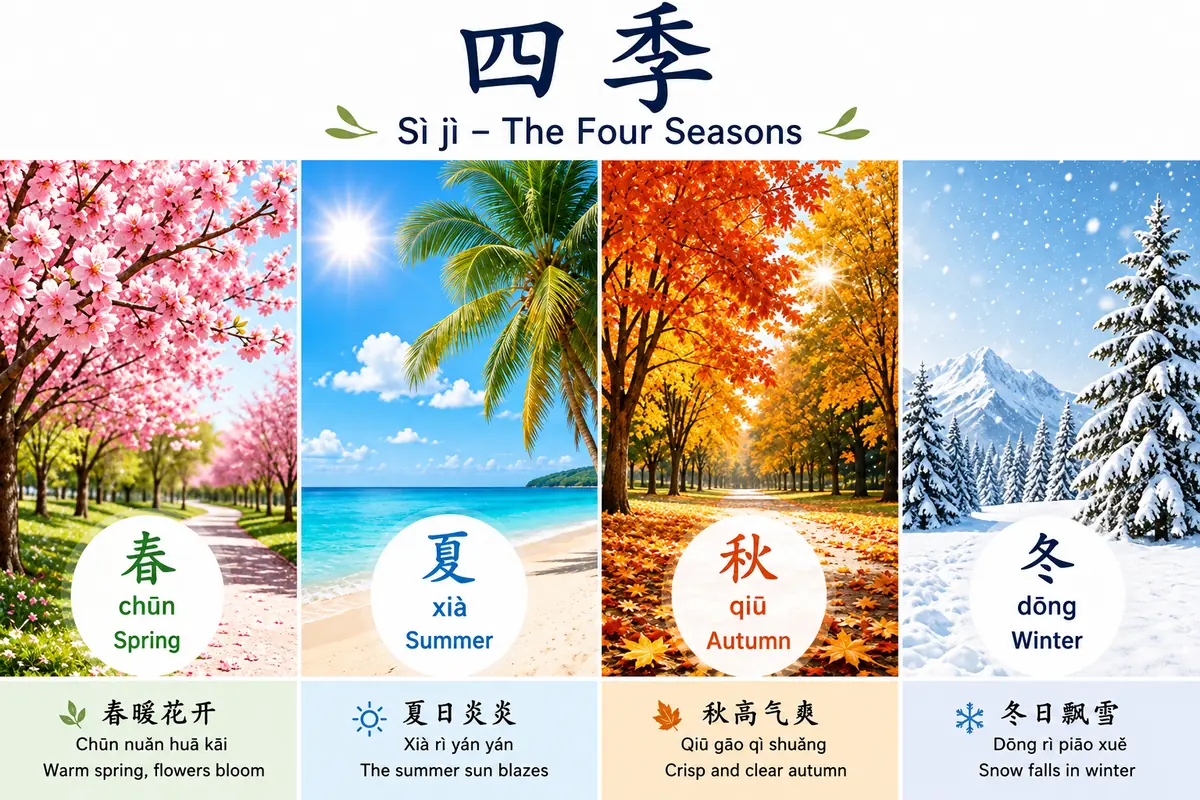
The four seasons are:
春天 — chūntiān — spring
夏天 — xiàtiān — summer
秋天 — qiūtiān — autumn
冬天 — dōngtiān — winter
You will also sometimes see the more formal forms:
春季 — chūnjì — spring season
夏季 — xiàjì — summer season
秋季 — qiūjì — autumn season
冬季 — dōngjì — winter season
For everyday conversation, however, 春天, 夏天, 秋天 and 冬天 are extremely common.
You may notice that all four everyday season words end in 天 (tiān).
It is worth being careful here: 天 does not mean “season” by itself. Its most common meanings include “day” and “sky”. In the four season words, it forms part of the everyday expression for the season.
You will see 天 in many other common words too:
今天 (jīntiān) — today
明天 (míngtiān) — tomorrow
天气 (tiānqì) — weather
Recognising recurring characters like this makes Mandarin much easier to understand. Instead of seeing every word as something completely separate, you begin noticing how familiar characters appear again and again.
Spring — 春天 (Chūntiān)
Spring has powerful associations in Chinese culture with renewal, warmer weather and the beginning of a new cycle.
It also connects naturally with 春节 (Chūnjié) — the Spring Festival, commonly known in English as Chinese New Year.
For many Chinese families, Spring Festival is one of the most important celebrations of the year. Large numbers of people travel home to spend time with their families, meals are shared, red decorations appear everywhere, and traditions vary considerably from region to region.
Dumplings are particularly associated with Spring Festival in northern China, while families in other parts of China may have very different traditional foods.
Firecrackers and fireworks are also traditional parts of the festival, although their use today depends on local rules and restrictions.
Some useful spring vocabulary includes:
暖和 (nuǎnhuo) — warm
下雨 (xiàyǔ) — to rain
花开了 (huā kāi le) — the flowers have bloomed
春天来了 (chūntiān lái le) — spring has arrived
A useful sentence is:
天气越来越暖了。
Tiānqì yuè lái yuè nuǎn le.
The weather is getting warmer and warmer.
The pattern 越来越 (yuè lái yuè) means “more and more” or “increasingly”.
It is one of those Mandarin structures that you can use in many different situations:
越来越冷
yuè lái yuè lěng
colder and colder
越来越热
yuè lái yuè rè
hotter and hotter
越来越好
yuè lái yuè hǎo
better and better
Once you learn the pattern, you can start building your own sentences rather than memorising them individually.
Summer — 夏天 (Xiàtiān)
Summer gives you plenty of opportunities to practise weather vocabulary.
China is a huge country, so summer conditions vary considerably, but many parts of the country experience very hot weather and some areas can become extremely humid.
You will often hear:
太热了!
Tài rè le!
It’s too hot!
Other useful summer vocabulary includes:
热 (rè) — hot
闷热 (mēnrè) — hot and muggy
出汗 (chūhàn) — to sweat
冰水 (bīngshuǐ) — iced water
空调 (kōngtiáo) — air conditioning
One habit that surprises some visitors is the preference many people in China have for warm or hot water, even when the weather is warm.
Because of this, you may hear:
多喝热水。
Duō hē rèshuǐ.
Drink more hot water.
This phrase can be advice, concern, habit or even a slightly humorous stock response to someone who is not feeling well.
It is better to understand this as a common cultural habit rather than assume that drinking hot water has special medical benefits.
Food also changes with the seasons.
Traditional Chinese ideas sometimes classify foods as being more “heating” or “cooling”, and these concepts can influence what some people choose to eat during hot weather.
Popular summer foods and drinks include:
西瓜 (xīguā) — watermelon
凉面 (liángmiàn) — cold noodles
绿豆汤 (lǜdòu tāng) — mung bean soup
This is another good example of how language connects directly with everyday life.
Autumn — 秋天 (Qiūtiān)
Autumn often has a particularly poetic feeling in Chinese literature.
In classical poetry, images such as autumn wind, falling leaves and the moon can evoke homesickness, distance, memory and the passing of time.
Useful autumn vocabulary includes:
凉快 (liángkuai) — pleasantly cool
秋风 (qiūfēng) — autumn wind
落叶 (luòyè) — fallen or falling leaves
A useful sentence is:
天气变凉了。
Tiānqì biàn liáng le.
The weather has become cooler.
Autumn is also associated with 中秋节 (Zhōngqiūjié) — the Mid-Autumn Festival.
Family reunion is an important theme of the festival. Mooncakes are traditionally eaten, and the full moon is strongly associated with togetherness and with thinking about family members who may be far away.
That connection between the moon, distance and reunion appears again and again in Chinese culture and literature.
Winter — 冬天 (Dōngtiān)
Winter can dramatically change everyday life in northern and northeastern China, including 东北 (Dōngběi).
Temperatures can become extremely cold, so clothing, heating and warming foods naturally become common conversation topics.
Hotpot, dumplings, soups and stews are all foods you may associate with colder weather, although of course many of them are eaten throughout the year too.
Some useful winter vocabulary includes:
冷 (lěng) — cold
下雪 (xiàxuě) — to snow
感冒 (gǎnmào) — a cold / to catch a cold
You may hear:
多穿点衣服。
Duō chuān diǎn yīfu.
Wear some more clothes.
Another very natural caring phrase is:
别着凉了。
Bié zháoliáng le.
Don’t get chilled.
Or:
小心别感冒了。
Xiǎoxīn bié gǎnmào le.
Be careful not to catch a cold.
These practical reminders can also tell you something about communication.
In some Chinese families and relationships, concern is often expressed through practical comments:
Have you eaten?
Are you cold?
Wear more clothes.
Get some rest.
Drink some water.
They may sound simple, but depending on the relationship and context, they can also be ways of showing care.
Why Everyday Mandarin Matters So Much
One thing I realised after years of trying to learn Mandarin is that conversational ability is not built only through complicated vocabulary.
It is built through ordinary life.
Weather. Food. Sleep. Being tired. Asking whether somebody has eaten. Talking about whether it is hot or cold outside.
That is real everyday Mandarin.
Beginners can sometimes become so focused on memorising vocabulary lists that they overlook the simple language they are most likely to use repeatedly.
But repetition is exactly what helps language become automatic.
Take a sentence as simple as:
今天很冷。
Jīntiān hěn lěng.
It’s very cold today.
Or:
我最喜欢秋天。
Wǒ zuì xǐhuān qiūtiān.
Autumn is my favourite season.
These sentences may look basic, but they are useful, natural and easy to adapt.
You can change just one word and suddenly create several new sentences:
今天很热。
Jīntiān hěn rè.
It’s very hot today.
我最喜欢春天。
Wǒ zuì xǐhuān chūntiān.
Spring is my favourite season.
That is how useful vocabulary becomes real language.
Why I Recommend Rocket Chinese
After trying apps, videos, random lessons and scattered study methods over the years, I eventually realised that I personally learn better when I have some structure.
That is one reason I like Rocket Chinese.
I find the combination of conversations, listening practice, pronunciation work and structured explanations useful because it gives me something organised to work through rather than constantly jumping between unrelated resources.
Rocket Chinese includes native-speaker audio, pronunciation practice, conversation activities, listening material and step-by-step explanations designed to help learners understand how Mandarin works.
What I particularly like is being able to learn a pattern and then recognise it later in a real conversation.
Topics such as weather, food, family and everyday life might not sound exciting when you first start learning Mandarin, but they are some of the topics you will actually use the most.
Final Thoughts
Learning the seasons in Mandarin teaches you far more than the words for spring, summer, autumn and winter.
You learn useful weather vocabulary.
You learn common sentence patterns.
You learn phrases people use to show concern.
And you begin noticing connections between language, food, festivals, family life and culture.
That is one of the things I enjoy most about learning Mandarin.
The more you understand the everyday language, the more you begin to understand not only the words people are saying, but also some of the cultural ideas behind them.