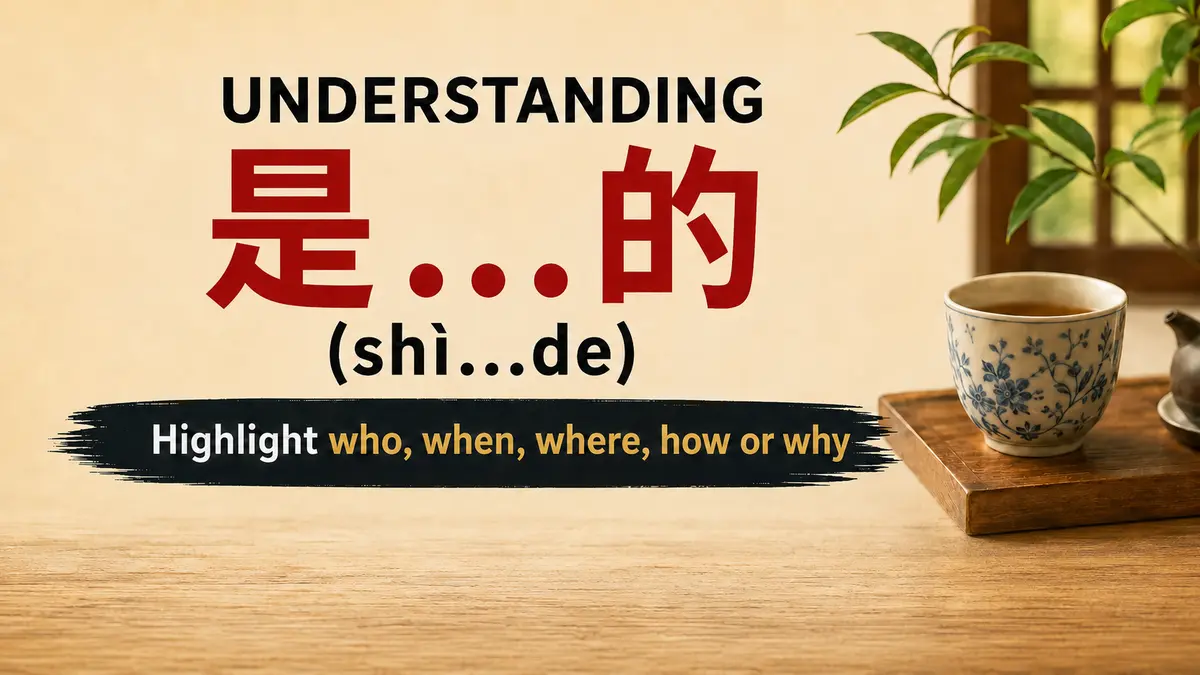
The shi de Chinese grammar pattern can look confusing at first. If you’ve been learning Mandarin for any length of time, you’ve probably come across sentences like this:
我是昨天来的。
Wǒ shì zuótiān lái de.
I came yesterday. / It was yesterday that I came.
Or:
是丽娜告诉我的。
Shì Lìnà gàosu wǒ de.
It was Lina who told me.
When I first started learning Chinese, sentences like these completely confused me.
I knew that 是 (shì) usually means “to be.”
I also knew that 的 (de) is commonly used to show possession or connect a description to a noun, as in:
我的书
Wǒ de shū
My book.
But when I saw 是 (shì) and 的 (de) together in the same sentence, I couldn’t work out what was happening.
Why was 是 (shì) there?
Why was 的 (de) at the end?
And what did either of them have to do with arriving yesterday?
Once I understood the 是……的 (shì…de) pattern, a huge amount of everyday Mandarin began to make sense. It looks strange at first, but once it clicks, you’ll start noticing it everywhere.
Why This Pattern Confuses Beginners
Most Mandarin learners meet 是 (shì) and 的 (de) separately before seeing them used together.
First, we learn:
- 是 (shì) = to be
- 的 (de) = a particle commonly used for possession or description
Then we suddenly encounter:
我是昨天来的。
Wǒ shì zuótiān lái de.
I came yesterday.
At first glance, the sentence doesn’t seem to follow the rules we’ve already learned.
The reason is that 是……的 (shì…de) works as a grammar pattern of its own. It is commonly used to focus attention on a particular detail about an event or situation.
What Does 是……的 (shì…de) Actually Do?
The easiest way to understand 是……的 (shì…de) is to imagine a spotlight.
The event is usually already known, assumed or treated as established. You then use 是……的 (shì…de) to place the spotlight on one particular detail:
- Who did it?
- When did it happen?
- Where did it happen?
- How did it happen?
- Why did it happen?
English can create a similar effect with stress or a sentence such as:
- “It was yesterday that I arrived.”
- “It was Sunny who told me.”
- “I came by car.”
English doesn’t always need the full “It was … that …” construction, so the most natural English translation may look like an ordinary sentence. The emphasis comes from the Mandarin structure and the context.
The Basic Pattern
Subject or topic + 是 + focused information + verb (+ object) + 的
For example:
我是昨天来的。
Wǒ shì zuótiān lái de.
I came yesterday. / It was yesterday that I came.
The detail after 是 (shì) is usually the information being highlighted.
This formula is a useful beginner guide. In longer sentences, especially those containing an object, the word order can vary slightly.
1. Emphasising Time: When Did It Happen?
我是昨天到的。
Wǒ shì zuótiān dào de.
I arrived yesterday. / It was yesterday that I arrived.
The arrival is treated as known. The emphasis is on 昨天 (zuótiān) — yesterday.
Compare these two sentences:
我昨天到了。
Wǒ zuótiān dào le.
I arrived yesterday.
This reports the arrival.
我是昨天到的。
Wǒ shì zuótiān dào de.
It was yesterday that I arrived.
This focuses specifically on when the arrival occurred.
Both sentences are correct, but they place the emphasis in different places.
2. Emphasising Place or Origin: Where?
我是从新西兰来的。
Wǒ shì cóng Xīnxīlán lái de.
I’m from New Zealand.
In an introduction, this very common sentence normally describes your place of origin rather than a particular journey you have just completed.
As a New Zealander learning Mandarin, this is a sentence I’ve used many times when talking with Chinese speakers.
You can use the same pattern with a city:
我是从奥克兰来的。
Wǒ shì cóng Àokèlán lái de.
I’m from Auckland.
To emphasise where a particular event happened, use 在 (zài) before the place:
我们是在咖啡馆认识的。
Wǒmen shì zài kāfēiguǎn rènshi de.
We met in a café. / It was in a café that we met.
3. Emphasising Method: How Did It Happen?
我是开车来的。
Wǒ shì kāichē lái de.
I came by car.
The emphasis is on how I arrived.
Other common examples include:
我是坐地铁来的。
Wǒ shì zuò dìtiě lái de.
I came by subway.
我是坐高铁来的。
Wǒ shì zuò gāotiě lái de.
I came by high-speed train.
我是走路来的。
Wǒ shì zǒulù lái de.
I came on foot.
This is one of the most useful real-life applications of the pattern.
4. Emphasising the Person: Who Did It?
是 Sunny 告诉我的。
Shì Sunny gàosu wǒ de.
It was Sunny who told me.
The emphasis is on the person who gave me the information.
This structure is especially useful when identifying the person responsible or correcting an assumption:
不是他,是她教我的。
Bú shì tā, shì tā jiāo wǒ de.
It wasn’t him. It was her who taught me.
The spoken words for 他 (tā), “he,” and 她 (tā), “she,” sound identical. The written characters show the difference.
5. Emphasising a Reason: Why?
The same structure can also highlight why something happened:
我是因为 Sunny 才开始学中文的。
Wǒ shì yīnwèi Sunny cái kāishǐ xué Zhōngwén de.
I started learning Chinese because of Sunny.
The focus is on the reason I started learning Mandarin.
Useful 是……的 (shì…de) Questions
You’ll often hear this structure in questions asking for details about an event:
你是什么时候来的?
Nǐ shì shénme shíhou lái de?
When did you arrive?
你是从哪儿来的?
Nǐ shì cóng nǎr lái de?
Where are you from?
你是怎么来的?
Nǐ shì zěnme lái de?
How did you get here?
是谁告诉你的?
Shì shéi gàosu nǐ de?
Who told you?
Learning these as complete questions will help you recognise the pattern in real conversations.
The Difference Between 是……的 (shì…de) and 了 (le)
Learners often confuse 是……的 (shì…de) with 了 (le) because both can appear when discussing past events. However, they do different jobs.
了 (le) can show that an action was completed or that a situation has changed. It isn’t simply a Mandarin past-tense marker.
是……的 (shì…de) focuses on the circumstances surrounding an event.
Compare:
我昨天买了这本书。
Wǒ zuótiān mǎi le zhè běn shū.
I bought this book yesterday.
This reports the purchase.
这本书是我昨天买的。
Zhè běn shū shì wǒ zuótiān mǎi de.
I bought this book yesterday. / It was yesterday that I bought this book.
This treats the purchase as established and focuses on details such as who bought the book or when it was bought.
是 (shì) Is Often Omitted in Conversation
In positive sentences, native speakers often leave out 是 (shì) when the meaning is clear:
我昨天来的。
Wǒ zuótiān lái de.
I came yesterday.
This is a natural shortened form of:
我是昨天来的。
Wǒ shì zuótiān lái de.
It was yesterday that I came.
However, 是 (shì) normally remains in the negative form:
我不是昨天来的。
Wǒ bú shì zuótiān lái de.
I didn’t come yesterday. / It wasn’t yesterday that I came.
Notice that this usually corrects the detail rather than denying the event itself. The sentence suggests that I did come, but on a different day.
An Important Correction: It Isn’t Only for Completed Actions
You’ll often see the beginner rule that 是……的 (shì…de) is used for completed actions.
That is usually a safe starting point, but it isn’t the whole story.
The pattern is most commonly used to discuss the details of a past or established event. However, it can also describe origin, purpose, identity or the nature of a situation.
For example:
我是来学中文的。
Wǒ shì lái xué Zhōngwén de.
I’m here to study Chinese.
The studying isn’t necessarily completed. The sentence explains the purpose of being here.
For beginners, the safest practical rule is:
Use 是……的 (shì…de) when an event or situation is already established and you want to focus on a particular detail about it.
For ordinary future plans, use a future expression instead:
我明天要去。
Wǒ míngtiān yào qù.
I’m going tomorrow.
In a normal conversation about future plans, 我是明天去的 (Wǒ shì míngtiān qù de) wouldn’t be the standard beginner form to use.
Why Learning 是……的 (shì…de) Matters
This isn’t an obscure textbook construction. It is a very common part of spoken and written Mandarin.
Once you understand it, you’ll begin noticing it in:
- everyday conversations
- Chinese television shows
- podcasts
- online videos
- real-life interactions
More importantly, you’ll be able to explain:
- where you’re from
- how you travelled somewhere
- when something happened
- where an event took place
- who did something
- why something happened
That is when Mandarin starts feeling less like translation and more like communication.
Examples From My Own Mandarin Journey
One of my biggest motivations for learning Mandarin is my girlfriend, Sunny.
Sunny is from Shenyang in northeastern China. Having a Chinese partner means I hear natural Mandarin every day and have plenty of opportunities to practise what I’m learning.
Here are some examples that relate to my own experience:
我们是在散步的时候开始练习英语的。
Wǒmen shì zài sànbù de shíhou kāishǐ liànxí Yīngyǔ de.
We started practising English while we were out walking.
我最初是在网上自学中文的。
Wǒ zuìchū shì zài wǎngshàng zìxué Zhōngwén de.
At first, I studied Mandarin independently online.
我们是在咖啡馆认识的。
Wǒmen shì zài kāfēiguǎn rènshi de.
We met in a café.
我是通过 Rocket Chinese 开始认真学习中文的。
Wǒ shì tōngguò Rocket Chinese kāishǐ rènzhēn xuéxí Zhōngwén de.
I began studying Mandarin seriously through Rocket Chinese.
Personal examples like these are much easier to remember than random textbook sentences because they connect the grammar to real experiences.
Quick Practice
Try translating these sentences before looking at the answers.
Questions
- I came by car.
- It was Sunny who told me.
- I’m from New Zealand.
- I arrived yesterday.
- We met in a café.
- I didn’t come by subway.
Answers
1. 我是开车来的。
Wǒ shì kāichē lái de.
I came by car.
2. 是 Sunny 告诉我的。
Shì Sunny gàosu wǒ de.
It was Sunny who told me.
3. 我是从新西兰来的。
Wǒ shì cóng Xīnxīlán lái de.
I’m from New Zealand.
4. 我是昨天到的。
Wǒ shì zuótiān dào de.
I arrived yesterday.
5. 我们是在咖啡馆认识的。
Wǒmen shì zài kāfēiguǎn rènshi de.
We met in a café.
6. 我不是坐地铁来的。
Wǒ bú shì zuò dìtiě lái de.
I didn’t come by subway.
Learning Grammar Is Easier With Context
One mistake I made early in my Mandarin journey was trying to memorise grammar rules in isolation.
I could understand a rule on paper, but I struggled to use it naturally in conversation.
What helped me most was hearing grammar and sentence patterns repeatedly in realistic dialogue.
That is one reason I like Rocket Chinese.
Its beginner course breaks conversations into manageable sections and explains grammar and pronunciation step by step. Hearing Mandarin used in context helped me understand when different patterns sound natural rather than simply memorising a rule.
If you’re interested, read my Rocket Chinese Review 2026 and my Rocket Chinese vs Duolingo comparison, where I explain what worked best for me as an adult learner.
Final Thoughts
The 是……的 (shì…de) pattern is one of the most useful grammar structures in Mandarin.
At first, it seems confusing because 是 (shì) and 的 (de) are familiar words that suddenly appear together in a different kind of sentence.
The key idea isn’t simply “past action.” The structure places a spotlight on an important detail about an event or situation.
Remember these five questions:
- Who?
- When?
- Where?
- How?
- Why?
If the event is already established and you want to highlight one of those details, 是……的 (shì…de) is often exactly the pattern you need.
Keep listening for it, keep practising it and, before long, you’ll start using it naturally in your own conversations.
加油!
Jiāyóu!
Keep going — you’ve got this.