Mandarin Grammar Is Easier Than You Think
When I first began learning Mandarin, I expected the grammar to be as difficult as the writing system. Chinese characters looked completely unfamiliar, so I assumed the sentence rules would be complicated too.
They are not. Mandarin grammar has its challenges, but beginners get several welcome advantages: verbs do not conjugate for person or number, nouns do not have grammatical gender, and there are no verb endings to memorise for past, present and future tense.
That does not mean Mandarin has no way to talk about time. It uses time words, context and aspect markers to show whether an action is complete, ongoing or experienced. Word order also matters more than many English speakers initially expect.
This Mandarin grammar guide for beginners explains the patterns that will help you build accurate, natural sentences without burying you in technical terminology.
What You Will Learn
- Basic subject–verb–object word order
- How Mandarin expresses identity, possession and description
- Where time and location phrases belong
- The difference between 不 (bù) and 没 (méi)
- Four common ways to ask questions
- How to use modal verbs such as 想 (xiǎng), 会 (huì) and 可以 (kěyǐ)
- Possession and description with 的 (de)
- Aspect markers such as 了 (le), 过 (guo) and 着 (zhe)
- Measure words
- Result complements
- Comparisons with 比 (bǐ)
- The 把 (bǎ) sentence pattern
- Topic–comment sentences
Here are four simple sentences you will understand by the end of this guide:
我爱你。
Wǒ ài nǐ.
I love you.
她今天不来。
Tā jīntiān bù lái.
She is not coming today.
你吃饭了吗?
Nǐ chīfàn le ma?
Have you eaten?
我在家学中文。
Wǒ zài jiā xué Zhōngwén.
I study Chinese at home.
1. The Basic Pattern: Subject–Verb–Object
The foundation of many Mandarin sentences is the same as it is in English:
Subject + Verb + Object
For example:
我爱你。
Wǒ ài nǐ.
I love you.
我喝咖啡。
Wǒ hē kāfēi.
I drink coffee.
她学中文。
Tā xué Zhōngwén.
She studies Chinese.
我看书。
Wǒ kàn shū.
I read books.
你说普通话。
Nǐ shuō Pǔtōnghuà.
You speak Mandarin.
One major advantage is that Mandarin verbs do not change according to the subject. The verb 喝 (hē), meaning “to drink”, stays the same in all of these phrases:
- 我喝 (wǒ hē) — I drink
- 你喝 (nǐ hē) — you drink
- 他喝 (tā hē) — he drinks
- 我们喝 (wǒmen hē) — we drink
- 他们喝 (tāmen hē) — they drink
Mandarin also allows speakers to leave out a subject or object when it is already obvious from the conversation.
你吃饭了吗?
Nǐ chīfàn le ma?
Have you eaten?
吃了。
Chī le.
Yes, I have.
The answer does not need 我 (wǒ), because everyone already knows who is speaking.
2. Using 是 (shì), 有 (yǒu) and Adjectives
English uses the verb “to be” in many different situations. Mandarin divides those jobs between several patterns.
是 (shì): Identifying or Classifying Something
Use 是 (shì) to connect one noun with another noun or noun phrase.
我是老师。
Wǒ shì lǎoshī.
I am a teacher.
他是我朋友。
Tā shì wǒ péngyou.
He is my friend.
这是我的书。
Zhè shì wǒ de shū.
This is my book.
有 (yǒu): Having or Existing
Use 有 (yǒu) to talk about possession or to say that something exists.
我有两个孩子。
Wǒ yǒu liǎng ge háizi.
I have two children.
桌子上有一本书。
Zhuōzi shàng yǒu yì běn shū.
There is a book on the table.
Adjectives Can Act Like Predicates
You normally do not put 是 directly before a simple adjective. Mandarin adjectives can act as the main predicate of a sentence.
我很累。
Wǒ hěn lèi.
I am tired.
今天很冷。
Jīntiān hěn lěng.
It is cold today.
In a neutral description, 很 (hěn) often links the subject and adjective smoothly. It may mean “very”, but it is not always strongly emphasised. Saying 我累 (wǒ lèi) is possible, although it can sound more contrastive: “I am tired” or “As for me, I’m tired.”
A common beginner mistake is to translate “I am tired” as 我是很累. In an ordinary description, say 我很累 instead.
3. Time Words Usually Come Before the Verb
Mandarin verbs do not change form to show past, present or future. Instead, speakers use time expressions and context.
Time words normally appear after the subject or at the beginning of the sentence:
Subject + Time + Verb + Object
or:
Time + Subject + Verb + Object
For example:
我昨天去了北京。
Wǒ zuótiān qù le Běijīng.
I went to Beijing yesterday.
昨天我去了北京。
Zuótiān wǒ qù le Běijīng.
Yesterday, I went to Beijing.
Both sentences are correct. Putting 昨天 (zuótiān) first makes “yesterday” the setting for the whole sentence.
More examples:
我今天上班。
Wǒ jīntiān shàngbān.
I am working today.
她明天来。
Tā míngtiān lái.
She is coming tomorrow.
我们今天上午开会。
Wǒmen jīntiān shàngwǔ kāihuì.
We have a meeting this morning.
他每天跑步。
Tā měitiān pǎobù.
He runs every day.
我星期一有课。
Wǒ xīngqīyī yǒu kè.
I have class on Monday.
The useful beginner rule is simple: set the time before you describe the action.
4. Location and the Different Uses of 在 (zài)
When a location tells us where an action takes place, the location phrase normally comes before the action verb.
Subject + Time + 在 + Place + Verb + Object
我在家学中文。
Wǒ zài jiā xué Zhōngwén.
I study Chinese at home.
他在图书馆看书。
Tā zài túshūguǎn kàn shū.
He reads in the library.
她在餐厅吃饭。
Tā zài cāntīng chīfàn.
She eats at a restaurant.
我们今天在公园跑步。
Wǒmen jīntiān zài gōngyuán pǎobù.
We are running in the park today.
在 can also be the main verb, meaning “to be at” or “to be located”.
我在家。
Wǒ zài jiā.
I am at home.
An Important Exception: Destinations
A place comes after a movement verb when it is the destination rather than the setting of the action.
我去北京。
Wǒ qù Běijīng.
I am going to Beijing.
她回家了。
Tā huí jiā le.
She has gone home.
Some verbs also form patterns in which the place follows the verb:
他住在上海。
Tā zhù zài Shànghǎi.
He lives in Shanghai.
So “location before the verb” is an excellent default rule, but it is not universal.
5. Negation: 不 (bù) and 没 (méi)
Mandarin usually makes a sentence negative by placing a negative word before the verb or adjective. The two negatives beginners use most often are 不 (bù) and 没 (méi), or its full form 没有 (méiyǒu).
Use 不 (bù) for Habits, States, Opinions and Intentions
我不喝酒。
Wǒ bù hē jiǔ.
I do not drink alcohol.
她不喜欢咖啡。
Tā bù xǐhuan kāfēi.
She does not like coffee.
我不去。
Wǒ bù qù.
I am not going.
我不是老师。
Wǒ bú shì lǎoshī.
I am not a teacher.
The pronunciation of 不 changes from bù to bú before another fourth-tone syllable, as in 不是 (bú shì).
Use 没 (méi) for an Action That Did Not Happen or Has Not Happened
我没吃早饭。
Wǒ méi chī zǎofàn.
I did not eat breakfast.
他还没来。
Tā hái méi lái.
He has not arrived yet.
我们没看那部电影。
Wǒmen méi kàn nà bù diànyǐng.
We did not watch that film.
我没去过上海。
Wǒ méi qù guo Shànghǎi.
I have never been to Shanghai.
Use 没有 (méiyǒu), not 不有, to negate 有:
我没有时间。
Wǒ méiyǒu shíjiān.
I do not have time.
When 没 negates a completed action, the perfective 了 is normally omitted:
- 我吃了早饭。(Wǒ chī le zǎofàn.) — I ate breakfast.
- 我没吃早饭。(Wǒ méi chī zǎofàn.) — I did not eat breakfast.
Do not reduce the distinction to “不 for present and 没 for past”. Past habits and states can still use 不:
我小时候不喜欢咖啡。
Wǒ xiǎoshíhou bù xǐhuan kāfēi.
I did not like coffee when I was a child.
The real question is whether you are negating a general state or intention with 不, or saying that an event did not occur with 没.
6. Four Common Ways to Ask Questions
Mandarin does not normally rearrange the subject and verb to form a question. You can add a particle, use an A-not-A pattern or put a question word where the answer would appear.
Method 1: Add 吗 (ma)
Add 吗 to the end of a statement to turn it into a neutral yes-or-no question.
你是学生吗?
Nǐ shì xuésheng ma?
Are you a student?
她明天来吗?
Tā míngtiān lái ma?
Is she coming tomorrow?
你喜欢音乐吗?
Nǐ xǐhuan yīnyuè ma?
Do you like music?
Method 2: Use the A-not-A Pattern
Repeat the verb or adjective in its positive and negative forms.
你去不去?
Nǐ qù bu qù?
Are you going?
你喜欢不喜欢?
Nǐ xǐhuan bu xǐhuan?
Do you like it?
他是不是你朋友?
Tā shì bu shì nǐ péngyou?
Is he your friend?
你忙不忙?
Nǐ máng bu máng?
Are you busy?
Do not combine this pattern with 吗. Say 你去不去?, not 你去不去吗?
Method 3: Put a Question Word Where the Answer Belongs
Mandarin question words usually remain in the same position that the answer would occupy.
你叫什么名字?
Nǐ jiào shénme míngzi?
What is your name?
你在哪儿?
Nǐ zài nǎr?
Where are you?
You can also say 你在哪里?(Nǐ zài nǎlǐ?). Both 哪儿 (nǎr) and 哪里 (nǎlǐ) mean “where”.
谁是你的老师?
Shéi shì nǐ de lǎoshī?
Who is your teacher?
你为什么学中文?
Nǐ wèishénme xué Zhōngwén?
Why are you learning Chinese?
你怎么去?
Nǐ zěnme qù?
How are you getting there?
这个多少钱?
Zhège duōshao qián?
How much is this?
Do not add 吗 when the sentence already contains a question word. Say 你叫什么名字?, not 你叫什么名字吗?
Method 4: Use 呢 (ne) for a Follow-up Question
呢 often means “What about…?” or “And…?” when the missing meaning is clear from the conversation.
我很好,你呢?
Wǒ hěn hǎo, nǐ ne?
I am well. What about you?
我明天去,你呢?
Wǒ míngtiān qù, nǐ ne?
I am going tomorrow. What about you?
呢 has other uses too, including softening some questions, but this follow-up pattern is the most useful place for a beginner to start.
7. Modal Verbs Come Before the Main Verb
Words that express a wish, ability, possibility, permission or necessity normally come before the main action verb.
Subject + Modal Verb + Main Verb + Object
我想学中文。
Wǒ xiǎng xué Zhōngwén.
I want to learn Chinese.
我会说一点中文。
Wǒ huì shuō yìdiǎn Zhōngwén.
I can speak a little Chinese.
Here, 会 (huì) means a learned ability. 能 (néng) often refers to ability or possibility based on the circumstances.
我今天不能去。
Wǒ jīntiān bù néng qù.
I cannot go today.
可以 (kěyǐ) commonly expresses permission or something being allowed.
我可以进去吗?
Wǒ kěyǐ jìnqu ma?
May I go in?
要 (yào) can express intention, a future plan, a need or “have to”, depending on context.
我明天要上班。
Wǒ míngtiān yào shàngbān.
I have to work tomorrow.
These words do not map perfectly onto a single English verb, so learn them through complete sentences rather than one-word translations.
8. Possession and Description with 的 (de)
The particle 的 (de) connects a possessor or description to a noun.
Possessor + 的 + Noun
我的书
wǒ de shū
my book
老师的手机
lǎoshī de shǒujī
the teacher’s phone
这是我的咖啡。
Zhè shì wǒ de kāfēi.
This is my coffee.
The noun can be omitted when everyone knows what you mean:
这本书是我的。
Zhè běn shū shì wǒ de.
This book is mine.
Description + 的 + Noun
好吃的菜
hǎochī de cài
delicious food
漂亮的地方
piàoliang de dìfang
a beautiful place
With close family relationships and some familiar combinations, 的 is often omitted:
我妈妈
wǒ māma
my mother
Beginners sometimes insert 的 between every pair of nouns. It is better to learn common phrases as complete units and notice when native speakers leave it out.
9. Aspect: Completed, Experienced and Ongoing Actions
Mandarin does not mark tense on the verb, but it does use aspect to show how an action unfolds. Aspect can tell us that an event is viewed as complete, has been experienced before, is currently in progress or remains in a continuing state.
了 (le): A Completed or Bounded Event
The perfective 了 often follows a verb to present an event as a complete whole.
我买了一本书。
Wǒ mǎi le yì běn shū.
I bought a book.
我们看了那部电影。
Wǒmen kàn le nà bù diànyǐng.
We watched that film.
However, 了 is not simply a past-tense marker. It can appear in a future setting when one action will be completed before another:
明天我吃了早饭就去机场。
Míngtiān wǒ chī le zǎofàn jiù qù jīchǎng.
Tomorrow, once I have eaten breakfast, I will go to the airport.
Sentence-final 了: A New Situation or Change of State
A 了 at the end of a sentence can signal that the situation is now different.
下雨了。
Xiàyǔ le.
It has started raining.
我不喝咖啡了。
Wǒ bù hē kāfēi le.
I do not drink coffee anymore.
The perfective 了 after a verb and the change-of-state 了 at the end of a sentence are related, but they do different jobs. Sometimes one 了 can be understood in both ways, which is why it takes time to master.
过 (guo): Past Experience
Use 过 to say that someone has experienced something at least once before.
我去过北京。
Wǒ qù guo Běijīng.
I have been to Beijing.
你吃过饺子吗?
Nǐ chī guo jiǎozi ma?
Have you ever eaten dumplings?
我没看过这部电影。
Wǒ méi kàn guo zhè bù diànyǐng.
I have never seen this film.
在 (zài) or 正在 (zhèngzài): An Action in Progress
Put 在 or 正在 before an action verb to show that the action is happening now. 呢 may also appear at the end.
我在吃饭。
Wǒ zài chīfàn.
I am eating.
她正在看书呢。
Tā zhèngzài kàn shū ne.
She is reading right now.
着 (zhe): A Continuing State
着 usually follows a verb and describes a state that continues.
门开着。
Mén kāi zhe.
The door is open.
她穿着一条红裙子。
Tā chuān zhe yì tiáo hóng qúnzi.
She is wearing a red dress.
着 is not a general replacement for the English “-ing” form. For an active event happening right now, 在 or 正在 is usually the better beginner pattern.
10. Measure Words
In Mandarin, a number or demonstrative such as “this” or “that” normally needs a classifier or measure word before a countable noun.
The general pattern is:
Number/Demonstrative + Measure Word + Noun
个 (gè)
个 is the most common general classifier. It is used with people and many everyday nouns.
三个人
sān ge rén
three people
本 (běn)
Used for books, magazines and other bound items.
一本书
yì běn shū
one book
张 (zhāng)
Used for many flat objects, including paper, tickets, maps, photographs and tables.
两张票
liǎng zhāng piào
two tickets
条 (tiáo)
Used for many long, narrow or flexible things, as well as fish and some items of clothing.
一条鱼
yì tiáo yú
one fish
杯 (bēi)
Used for a cup or glass of a drink.
一杯茶
yì bēi chá
a cup of tea
只 (zhī)
Used for many animals and for one of a pair.
两只猫
liǎng zhī māo
two cats
Measure words are also used after demonstratives:
这本书
zhè běn shū
this book
那张票
nà zhāng piào
that ticket
A Useful Note About 两 (liǎng)
Before a measure word, use 两 (liǎng) more often than 二 (èr) for “two”:
两本书
liǎng běn shū
two books
You still use 二 in numbers such as 十二 (shí’èr, twelve) and 二十 (èrshí, twenty).
个 is a useful fallback when you cannot remember a more specific classifier, but it is not correct or natural for every noun. Learn the common measure word together with each new noun: 一本书, 一张票, 一条鱼.
11. Result Complements: Showing What Happened in the End
Mandarin often places a short element after a verb to show the result of an action. These result complements make the outcome clear.
Common examples include:
- 完 (wán) — finish
- 好 (hǎo) — complete successfully or make ready
- 到 (dào) — reach or achieve
- 懂 (dǒng) — understand successfully
- 见 (jiàn) — perceive successfully
我吃完了。
Wǒ chī wán le.
I have finished eating.
作业做好了。
Zuòyè zuò hǎo le.
The homework is finished.
我找到钥匙了。
Wǒ zhǎo dào yàoshi le.
I found the keys.
你听懂了吗?
Nǐ tīng dǒng le ma?
Did you understand what you heard?
我没看见他。
Wǒ méi kàn jiàn tā.
I did not see him.
English often leaves the result to context. Mandarin frequently states it directly, so learning common verb–result combinations will make your speech clearer and more natural.
12. Making Comparisons with 比 (bǐ)
The basic pattern for comparing two things is:
A + 比 + B + Adjective
今天比昨天冷。
Jīntiān bǐ zuótiān lěng.
Today is colder than yesterday.
这本书比那本书贵。
Zhè běn shū bǐ nà běn shū guì.
This book is more expensive than that one.
她比我高。
Tā bǐ wǒ gāo.
She is taller than me.
You can add 一点儿 (yìdiǎnr) for “a little” or 得多 (de duō) for “much”.
这个比那个便宜一点儿。
Zhège bǐ nàge piányi yìdiǎnr.
This one is a little cheaper than that one.
今天比昨天冷得多。
Jīntiān bǐ zuótiān lěng de duō.
Today is much colder than yesterday.
Do not normally add 很 (hěn) directly before the adjective in a basic 比 sentence. 比 already establishes the comparison.
To say that A is not as adjective as B, use:
A + 没有 + B + Adjective
这个房间没有那个房间大。
Zhège fángjiān méiyǒu nàge fángjiān dà.
This room is not as big as that one.
13. The 把 (bǎ) Sentence Pattern
The 把 pattern is more common from the late-beginner or intermediate stage, but it is useful to recognise early. It brings a specific or already-known object before the verb and focuses on how that object is handled, changed or affected.
A useful basic pattern is:
Subject + 把 + Object + Verb + Result/Location/Other Information
我把作业做完了。
Wǒ bǎ zuòyè zuò wán le.
I finished my homework.
请把门关上。
Qǐng bǎ mén guān shàng.
Please close the door.
他把手机放在桌子上了。
Tā bǎ shǒujī fàng zài zhuōzi shàng le.
He put the phone on the table.
她把衣服洗干净了。
Tā bǎ yīfu xǐ gānjìng le.
She washed the clothes clean.
A 把 sentence normally needs more than a bare verb. 我把书看 sounds unfinished. Say what happened to the book:
我把那本书看完了。
Wǒ bǎ nà běn shū kàn wán le.
I finished reading that book.
Do not force every sentence into a 把 construction. Use it when the object is known and the result, destination or effect on it matters.
14. Topic–Comment Sentences
Mandarin is often described as a topic-prominent language. A speaker can introduce what the sentence is about—the topic—and then say something about it.
Topic + Comment
这本书,我已经看完了。
Zhè běn shū, wǒ yǐjīng kàn wán le.
As for this book, I have already finished it.
四川菜,我特别喜欢。
Sìchuān cài, wǒ tèbié xǐhuan.
Sichuan food—I especially like it.
那个问题,我不知道。
Nàge wèntí, wǒ bù zhīdào.
As for that question, I do not know.
The neutral sentence 我特别喜欢四川菜 is also correct. Moving 四川菜 to the front makes it the topic and can create contrast with other foods. Topic–comment order is especially natural when the topic has already been mentioned or is clear from the situation.
Putting the Main Word Order Together
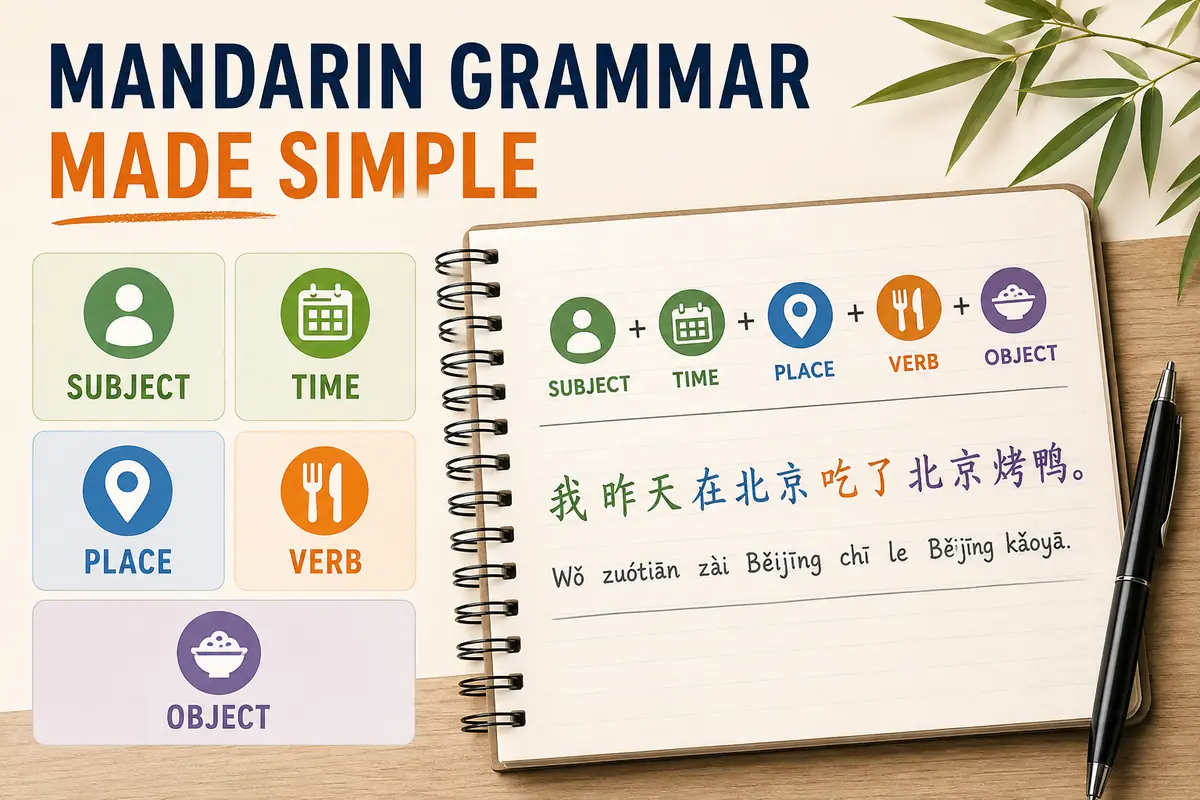
A useful default pattern for longer Mandarin sentences is:
Subject + Time + Location + Manner/Method + Verb + Object
You will not use every part in every sentence, and some verbs require a different order, but this pattern gives beginners a reliable starting point.
我昨天在北京吃了北京烤鸭。
Wǒ zuótiān zài Běijīng chī le Běijīng kǎoyā.
I ate Peking duck in Beijing yesterday.
- 我 (wǒ) — subject
- 昨天 (zuótiān) — time
- 在北京 (zài Běijīng) — location
- 吃了 (chī le) — action viewed as complete
- 北京烤鸭 (Běijīng kǎoyā) — object
Here is another example:
我今天在家用手机学中文。
Wǒ jīntiān zài jiā yòng shǒujī xué Zhōngwén.
I am studying Chinese on my phone at home today.
Mandarin builds sentences by setting the scene and then giving the action. Once that rhythm becomes familiar, longer sentences begin to feel much more natural.
Common Beginner Mistakes to Avoid
- Using 是 before every adjective
Say 我很累 (wǒ hěn lèi), not 我是很累. - Putting time and setting-location phrases after the verb
Start with the reliable pattern: subject + time + location + action. - Treating 了 as a past-tense ending
了 usually marks a completed event or a new situation; it does not automatically mean “past”. - Using 不 for every negative sentence
Use 没 for an event that did not happen or has not happened, and to negate 有. - Adding 吗 to an A-not-A or question-word question
Say 你去不去? or 你去哪儿?—not 你去不去吗? or 你去哪儿吗? - Forgetting measure words
Say 三个人 (sān ge rén) and 两本书 (liǎng běn shū), not 三人 or 两书 in ordinary beginner conversation. - Translating English word for word
Learn complete Mandarin patterns and pay attention to what native speakers actually say.
Key Grammar Takeaways
- Mandarin often follows subject–verb–object order, but context allows obvious subjects and objects to be omitted.
- Verbs do not conjugate. Time words, context and aspect show when and how an event happens.
- Time and setting-location phrases normally come before the main action verb.
- 是 links nouns; simple adjectives normally act as predicates without 是.
- 不 usually negates habits, states and intentions; 没 says an event did not occur and negates 有.
- Question words stay where the answer would normally appear.
- Modal verbs come before the main verb.
- 了, 过, 在/正在 and 着 describe different ways an action or state unfolds.
- Numbers and demonstratives normally require a measure word before a countable noun.
- Result complements tell the listener what an action achieved.
- 比 creates comparisons, while 把 highlights what happens to a known object.
- Topic–comment order is common when the topic is already understood or being contrasted.
Mandarin grammar is not effortless, but it is far less intimidating than it first appears. Start with a few dependable sentence patterns, listen for them in real conversations and use them repeatedly. Accuracy will grow through practice—not through memorising hundreds of abstract rules.
Ready to Put Your Grammar into Practice?
Understanding a rule is useful, but you only begin to own it when you hear it, recognise it and use it in a real sentence.
That is one reason I recommend Rocket Chinese. It introduces grammar through dialogues, listening practice and interactive lessons instead of presenting it as a long list of rules. If you are serious about building practical Mandarin, it is one of the most useful structured courses I have used.
Affiliate disclosure: If you buy through this link, I may earn a commission at no extra cost to you.