
Affiliate disclosure: This post contains affiliate links. If you purchase Rocket Chinese through my link, I may earn a commission at no extra cost to you. I only recommend products I have personally used and genuinely believe can help Mandarin learners.
Looking for the Best Mandarin Chinese Course?
If you are searching for the best way to learn Mandarin Chinese, you have probably already discovered something important: there is no shortage of choices.
There are apps, YouTube channels, podcasts, textbooks, tutors and complete online courses all promising to help you learn quickly. Some are useful. Some are entertaining. The difficult part is finding one that gives you a clear path from your first words to real conversations.
I have spent years learning Mandarin. I have travelled in China, studied from textbooks, used language apps, watched countless videos and spent many hours trying to improve my speaking and listening. For a long time, I collected bits of the language without knowing how they fitted together.
When people ask which complete Mandarin course I recommend most often, my answer is Rocket Chinese.
Not because it is perfect. It is not.
Not because one course can make anybody fluent. It cannot.
I recommend it because it is the most complete and well-structured Mandarin course I have personally used. It combines guided audio lessons with clear explanations, speaking practice, Chinese characters, review activities and cultural information.
If you want more than a few disconnected phrases or a daily app streak, Rocket Chinese deserves serious consideration.
Quick Verdict
My rating: 9/10
Best for
- Complete beginners and returning learners
- Adults who want clear explanations in English
- Travellers who want practical Mandarin
- People working with Chinese colleagues or companies
- Independent learners who need a structured path
- Learners who want to practise speaking, listening, reading and writing in one course
Less suitable for
- People who want a completely free course
- Learners who only want very short, game-like sessions
- Anyone who wants regular live teaching from a personal tutor
- Advanced learners looking mainly for unscripted native content
Bottom line
In my view, Rocket Chinese is one of the best all-round Mandarin courses for English-speaking adults. Its strongest features are the guided audio lessons, detailed explanations and the way it brings several essential skills together in one organised programme.
Try Rocket Chinese free. The free trial does not require a credit card, so you can judge the teaching style for yourself before buying.
My Experience Learning Mandarin
My interest in China goes back many years. During my time in the Royal New Zealand Navy, I visited China and became fascinated by the country, its culture and its people. Years later, I decided that I wanted to learn Mandarin properly.
Like many beginners, I started with free resources. I downloaded apps, watched YouTube videos, listened to podcasts and bought books.
The problem was not motivation. The problem was structure.
One resource taught a list of greetings. Another introduced a grammar point I was not ready for. A third gave me vocabulary with no clear way to use it in a conversation. I could remember individual words, but I struggled to turn them into speech.
Rocket Chinese was one of the first programmes that gave me a clear learning path. The material was arranged in a sensible order, and the explanations helped me understand why a sentence worked instead of asking me to copy it blindly.
It did not suddenly make Mandarin easy, but it stopped my study from feeling random. That was a major improvement.
Why Mandarin Benefits From a Structured Course
The U.S. Foreign Service Institute places Mandarin Chinese among the languages that are exceptionally difficult for native English speakers to learn. That does not mean Mandarin is impossible, but it does mean English speakers have several unfamiliar systems to master.
1. Tones and pronunciation
Standard Mandarin has four main lexical tones plus a neutral tone. The syllable ma, for example, can represent different words when spoken with different tones.
Context often helps a listener understand an imperfect tone, so one mistake will not always destroy a conversation. However, consistent tone errors can make you difficult to understand. Beginners therefore need to train their ears and voices early—not wait until pronunciation problems become habits.
2. Chinese characters
Written Chinese primarily uses characters, or 汉字 (Hànzì), rather than an alphabetic writing system. Pinyin uses the Latin alphabet to show pronunciation, but it is a learning and transcription tool, not a replacement for characters in normal Chinese writing.
You do not need to master thousands of characters before you start speaking. However, anyone who wants to read messages, menus, signs or articles will eventually need systematic character study.
3. Unfamiliar grammar patterns
Mandarin grammar is simpler than English in some respects. Verbs do not conjugate for person, and nouns usually do not change form to show plural number. Mandarin also does not mark tense on the verb in the same way English does.
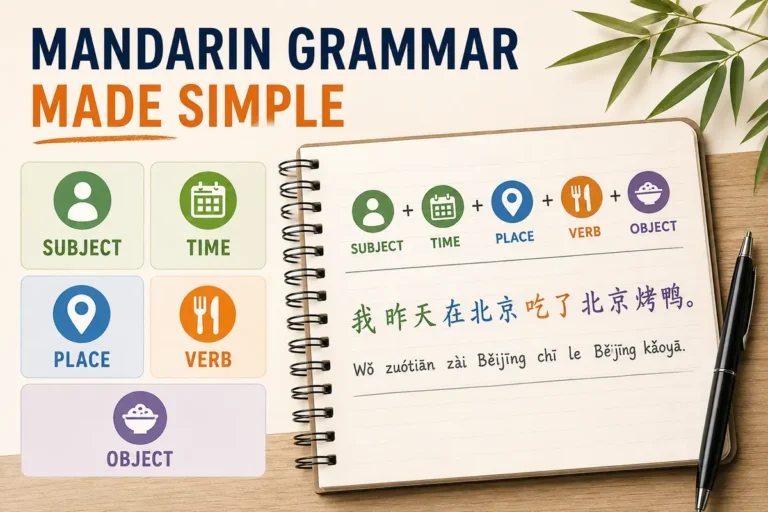
That does not mean Mandarin has no grammar. Word order, aspect particles such as 了 (le), measure words, topic-comment sentences and the way time and place are positioned can all feel unfamiliar to an English speaker. Clear explanations save a great deal of confusion.
4. Mostly unfamiliar vocabulary
Mandarin and English do not share a large stock of obvious cognates. Although modern Mandarin contains some loanwords and sound-based borrowings, most everyday vocabulary will feel completely new to an English speaker.
That makes regular review and repeated listening especially important.
What Makes Rocket Chinese Different?
1. Guided audio lessons
The audio lessons are the strongest part of the course for me. They are built around useful conversations and then break the language into manageable sections.
You hear the dialogue, practise the words and sentences, and receive explanations of vocabulary, grammar, pronunciation and usage. The hosts guide you through the material in English, which is particularly useful when Mandarin sentence structure differs from what an English speaker expects.
The conversations are scripted learning material rather than completely unscripted street Mandarin, but they give beginners a practical and understandable starting point.
2. Speaking and pronunciation practice
Rocket Chinese encourages you to speak from the beginning. Its Rocket Record tool lets you listen to a native-speaker recording, record your own voice, play it back and receive a voice-recognition score.
This is useful for repetition and for overcoming the fear of speaking aloud. The role-playing activities also let you take either side of a conversation, which is better preparation for real interaction than only recognising the correct answer on a screen.
However, voice recognition is a practice aid—not a replacement for feedback from a skilled teacher or native speaker. Automatic scores can sometimes be inconsistent, and Mandarin tones deserve human feedback when possible.
3. Reading and writing support
Rocket Chinese does not treat characters as an optional afterthought. It includes dedicated writing lessons and a script-writing tool to help learners practise reading and forming Hanzi. Pinyin is also included, and learners can choose to hide it when they are ready to rely more heavily on characters.
This is a much better balance than either ignoring characters or overwhelming a beginner with long lists to memorise.
Rocket’s character material gives you a useful foundation, but serious literacy will still require more reading. I would add graded readers, real messages and other level-appropriate Chinese texts as you progress.
4. Language and culture lessons
Learning Mandarin is not only about translating English sentences. You also need to understand how people greet one another, show politeness, order food, behave in social situations and communicate in different settings.
Rocket Chinese includes language-and-culture material covering everyday life and customs. These lessons cannot represent every region or every Chinese-speaking community, but they help explain the social setting around the language.
That context is valuable for an English speaker who may otherwise use a grammatically correct sentence in an unnatural way.
5. Reinforcement rather than one exposure
Meeting a word once is not learning it. Rocket’s reinforcement activities make you return to lesson vocabulary through listening, speaking, recall and writing tasks.
The course also tracks your progress and brings weaker material back for more practice. This does not remove the need for revision, but it gives you a ready-made system instead of leaving you to design one from scratch.
6. Flexible study and offline audio
Rocket Chinese works on desktop and through its iOS and Android apps. The podcast-style audio lessons can be downloaded in the mobile app for offline listening.
That makes it practical to study while walking, exercising, travelling or doing housework. I find this useful because it turns otherwise unused time into extra listening practice.
There is one important limitation: not every course feature works offline, and Rocket Record requires an internet connection. Audio lessons are downloadable through the mobile app, not from the desktop website.
7. Lifetime access
Rocket Chinese is sold by course level or as a bundle, and paid courses include lifetime access and future course updates. Rocket also currently offers a six-month payment plan and a 60-day money-back guarantee.
This can be better value than paying for a subscription year after year, especially if you learn slowly or expect to return to the material later. Prices and promotions change, so check the current offer before deciding.
Can You Learn Mandarin After 50?
Yes. Adults can learn Mandarin at 50, 60 or beyond.
You may not memorise new vocabulary as quickly as you did at school, but older learners often bring strengths that matter just as much: patience, discipline, life experience and a clear reason for learning.
The key is consistent, realistic practice. Short daily study is far more useful than one long session followed by weeks of doing nothing.
Rocket Chinese suits many adult learners because it explains the language directly. You are not expected to guess every grammar pattern from pictures or turn the whole process into a game. You can pause, repeat and revisit a lesson as often as necessary.
What I Do Not Like About Rocket Chinese
No honest review should pretend that a course has no weaknesses.
Some lessons feel long
The in-depth audio lessons are a strength, but they demand more concentration than a five-minute app exercise. Fortunately, you do not have to complete a full lesson in one sitting.
The presentation is functional rather than exciting
The interface works, but parts of it may feel less polished or playful than newer language apps. Learners who are motivated mainly by colourful games may prefer a different style.
Voice recognition has limits
Recording yourself is valuable, but an automatic percentage score cannot explain every problem with your tones, rhythm or mouth position. Use it for practice, not as proof that your pronunciation is perfect.
It is not a substitute for real conversation
Role-playing builds confidence, but a recording cannot react unpredictably, change the subject or ask you to clarify something. At some point, you need conversations with real people.
The character work needs outside reading
Rocket gives learners a good introduction to Hanzi, but reading fluently requires much more exposure. A graded-reader app or beginner books would be a useful companion.
The initial cost can feel high
Buying a full course or bundle costs more upfront than using a free app. Lifetime access may make it good long-term value, but only if you use it. Try the free material before spending money.
Rocket Chinese vs Other Popular Mandarin Courses
These are not identical products, and the right choice depends on how you prefer to learn.
Rocket Chinese vs Duolingo
Duolingo is useful for short, game-like practice and building a daily habit. Rocket Chinese offers longer guided audio lessons and more direct explanation of how Mandarin works.
If you only have a few minutes and want a free starting point, Duolingo may suit you. If you want a main course with a clearer path and more detailed instruction, I would choose Rocket Chinese.
Rocket Chinese vs Rosetta Stone
Rosetta Stone emphasises learning through images, context and immersion. Some learners enjoy discovering meaning in that way.
I prefer Rocket Chinese for Mandarin because its English explanations make unfamiliar word order, particles and cultural usage easier to understand. Learners who dislike translation and prefer a more intuitive visual approach may favour Rosetta Stone.
Rocket Chinese vs Pimsleur
Pimsleur is particularly strong for guided listening and speaking practice. Its Mandarin programme also includes reading material, but the central experience is still its audio method.
Rocket Chinese covers a broader mixture of explicit grammar, culture, reinforcement, Hanzi reading and writing. I would choose Pimsleur for an audio-first routine and Rocket Chinese for a more complete main course.
Rocket Chinese vs a private teacher
A good teacher can correct your tones, adapt lessons to your weaknesses and hold a real conversation with you. Rocket Chinese cannot do that.
On the other hand, a self-paced course is available whenever you want it and is usually less expensive than years of weekly lessons. For many learners, the strongest combination is Rocket Chinese for structure plus occasional tutoring or regular conversation practice for feedback.
Can Rocket Chinese Make You Fluent?
No course can make you fluent by itself.
Rocket Chinese can give you a strong, organised foundation and take you from beginner material into more advanced lessons. But real ability comes from using what you learn: listening to different speakers, reading new material, writing messages and having conversations in which you cannot predict every reply.
I would use Rocket Chinese as the backbone of a study plan, then add:
- Regular conversation with a teacher, partner or language-exchange friend
- Beginner-friendly podcasts and videos
- Graded readers and real Chinese messages
- Focused tone correction
- Spaced review of useful vocabulary
That is a more realistic route to confident communication than expecting one app or course to do everything.
Frequently Asked Questions
Is Rocket Chinese worth the money?
For a serious independent learner who wants structure, detailed explanations and lifetime access, I believe it is. It is less worthwhile if you only want occasional casual practice or know that you will not use longer lessons.
Does Rocket Chinese teach Chinese characters?
Yes. It includes Hanzi reading and writing lessons as well as pinyin. I would still add graded reading if literacy is an important goal.
Does Rocket Chinese offer a free trial?
Yes. The current free trial includes sample material and does not require a credit card.
Can I use Rocket Chinese offline?
You can download the podcast-style audio lessons in the iOS or Android app. Some features, including Rocket Record voice recognition, require an internet connection.
Is it suitable for complete beginners?
Yes. Level 1 is designed for learners with little or no previous Mandarin experience. Rocket also offers higher levels for learners who already know the basics.
Can I learn Mandarin using only Rocket Chinese?
You can build a strong foundation with it, but I would not rely on any single course. Add real conversations and a wider range of listening and reading material as soon as you can.
Final Verdict
After years of learning Mandarin and trying different resources, Rocket Chinese remains the complete course I recommend most often to English-speaking adults.
Its biggest strength is not one clever feature. It is the way the audio lessons, explanations, speaking practice, review, characters and culture work together in a clear sequence.
It will not make Mandarin effortless, and it will not replace real people. You still have to study consistently, practise tones and use the language outside the course.
But if you want a reliable structure instead of jumping between disconnected resources, Rocket Chinese is one of the best places to start.
Try Rocket Chinese free and decide for yourself.
Continue Learning Mandarin
Rocket Chinese vs a Mandarin Teacher
Should you invest in a Mandarin tutor or use a structured course? This article compares the costs, benefits, flexibility and limitations of both approaches.
Read Rocket Chinese vs a Mandarin Teacher: Which Is the Best Way to Learn Chinese in 2026?.
How Long Does It Really Take to Learn Mandarin?
Wondering how much time Mandarin really takes? This guide gives English speakers a realistic learning timeline.
Read How Long Does It Really Take to Learn Mandarin?.
The Absolute Beginner’s Guide to Learning Mandarin
Starting Mandarin can feel overwhelming when you do not know where to begin. This step-by-step guide covers pronunciation, tones, vocabulary and building a useful study routine.
Read The Absolute Beginner’s Guide to Learning Mandarin Chinese.